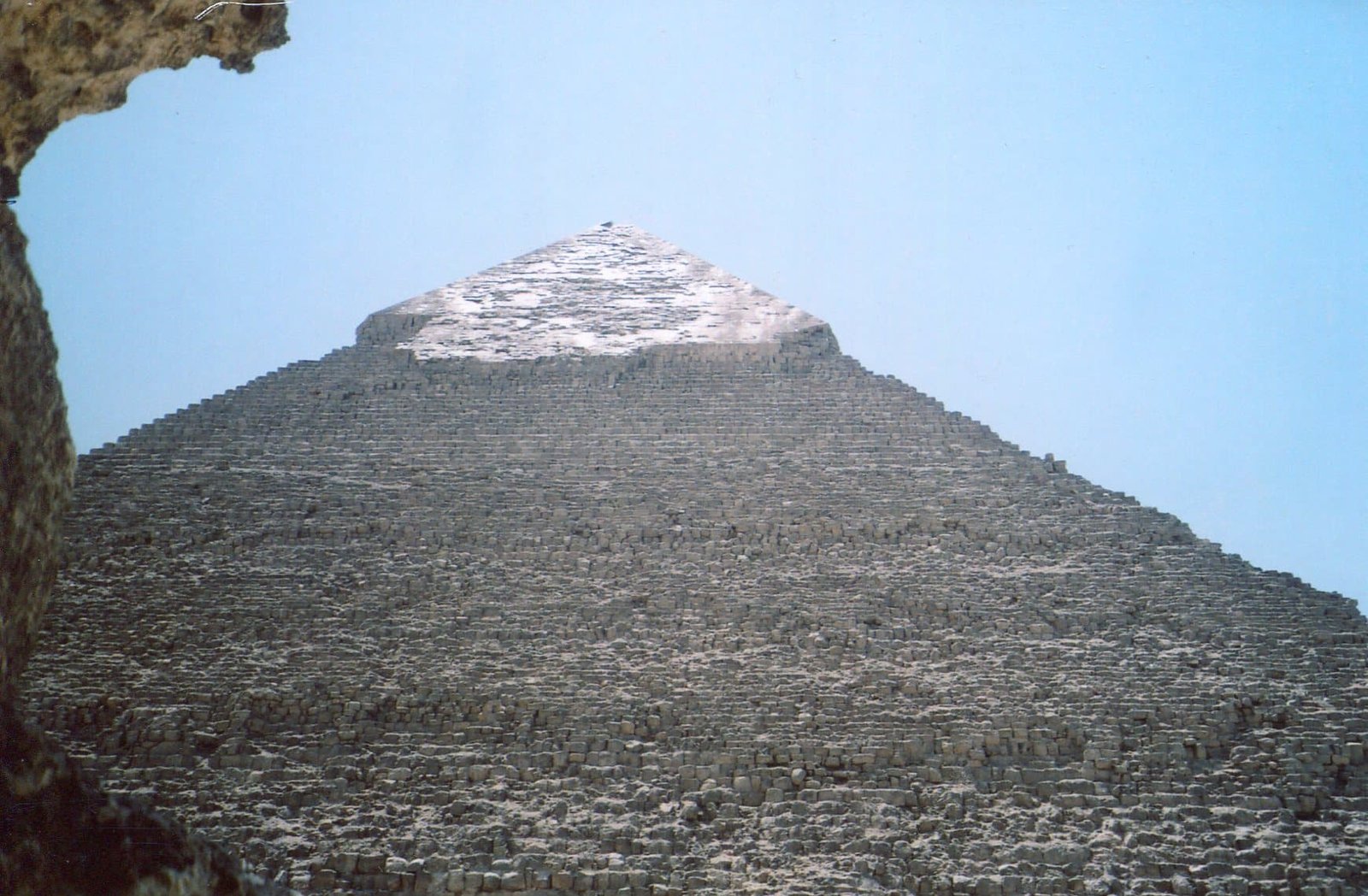
King Khufu’s Great Pyramid at Giza first stood alone. Imagine its glory as it rose about 480 feet from a cliff that presided over the Nile and the royal city of Memphis. It was within sight of Heliopolis, where the sun’s cult was centered.
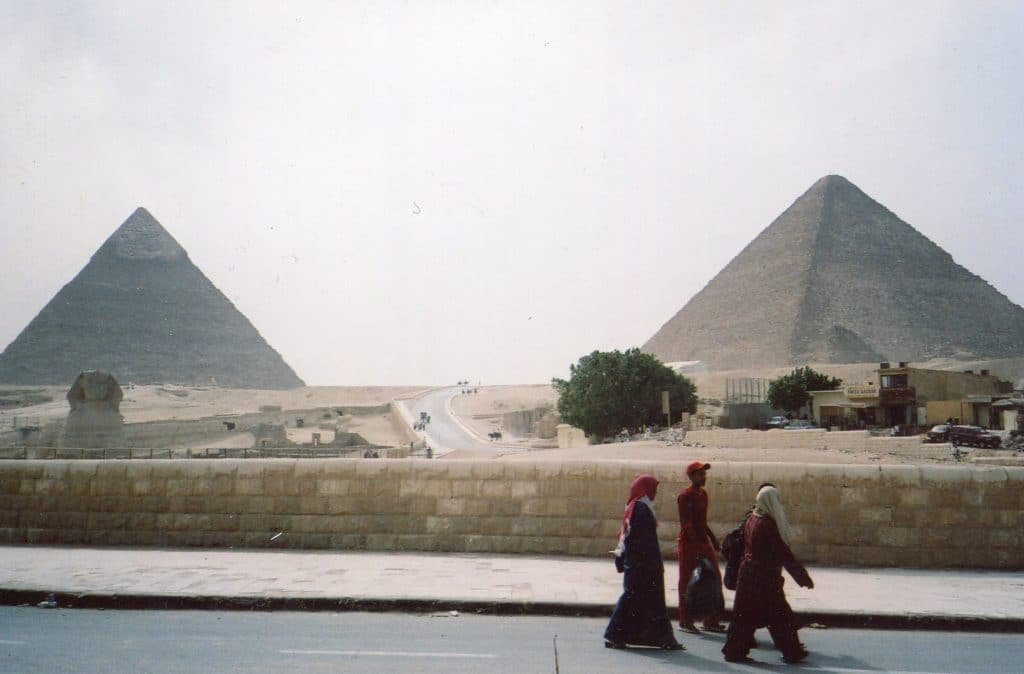
Khufu’s son Khafre erected his pyramid next to it. No two buildings have better complemented each other. Let’s explore the son’s work, starting with some basic facts:
1. Khufu had an older son, Djedefre, who first became the Pharaoh. He built his pyramid about five miles north, at Abu Roash. It was closer to the sun cult’s center at Heliopolis.
2. Khafre then succeeded his older brother, and he moved his burial site back to Giza.
3. The ground Khafre decided to build his pyramid on was sloped, and his builders had to level it. They cut the northwest corner down by 33 feet and built up the opposite corner with large stone blocks.
4. Khafre’s pyramid is a little shorter than Khufu’s. But the ground Khafre built his on is 33 feet higher, so its apex is a little higher than his father’s.
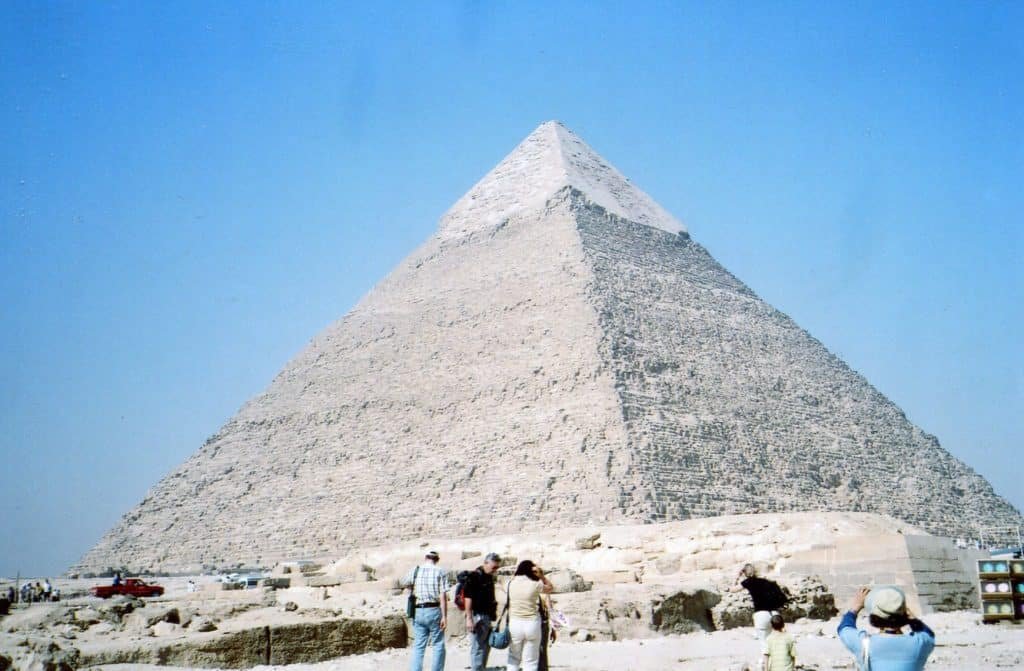
5. Khafre’s pyramid is a little steeper than Khufu’s. It rises at a 53-degree angle.
6. The top is a little twisted. Khafre’s builders didn’t quite properly align the four corners to meet at the apex. Pyramid building was still trial-and-error, and not an exact science.
7. The diagonals of both pyramids are aligned to point to Heliopolis.
These are some surface-level facts about Khafre’s pyramid. But like the Great Pyramid complex, the whole system of several buildings is much more interesting than the single pyramid. The other buildings that Khafre erected influenced ancient Egypt for the rest of her history.
As the kings built their pyramids at Giza, another major architectural form was developed. It later replaced the pyramid as ancient Egypt’s main type of royal construction project.
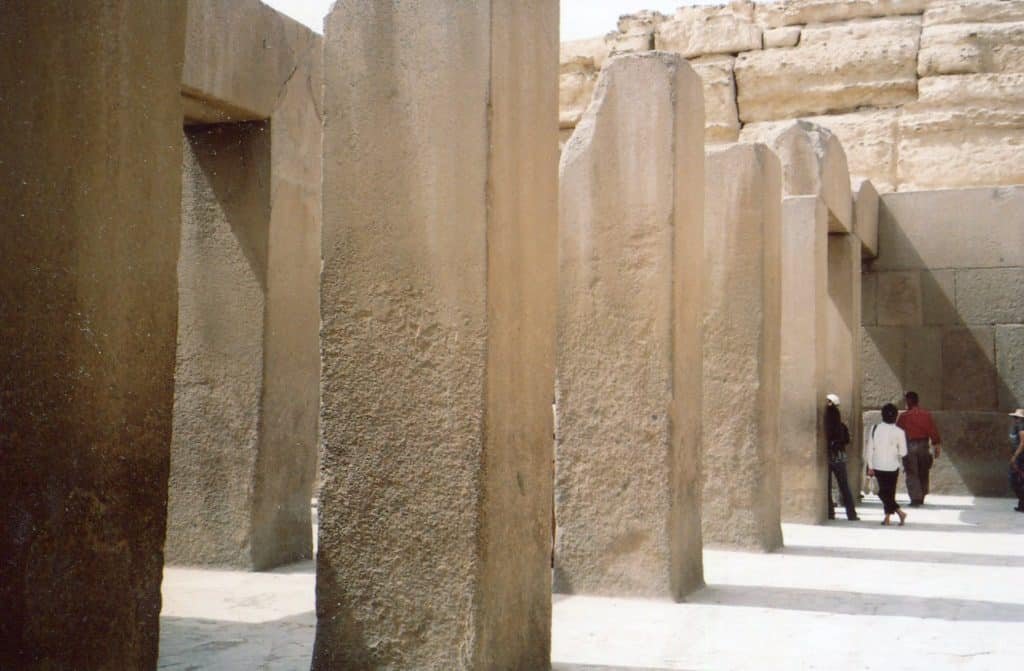
The above shot is from the inside of King Khafre’s valley temple. It’s one of three temples associated with his reign. Ancient Egyptians increasingly devoted more resources to temple construction, and temples later became their largest buildings. Khafre’s temples were huge advancements in this direction.
We’ll briefly look at each temple.
1. The valley temple is one of the two temples on the water front, where boats from the Nile docked.
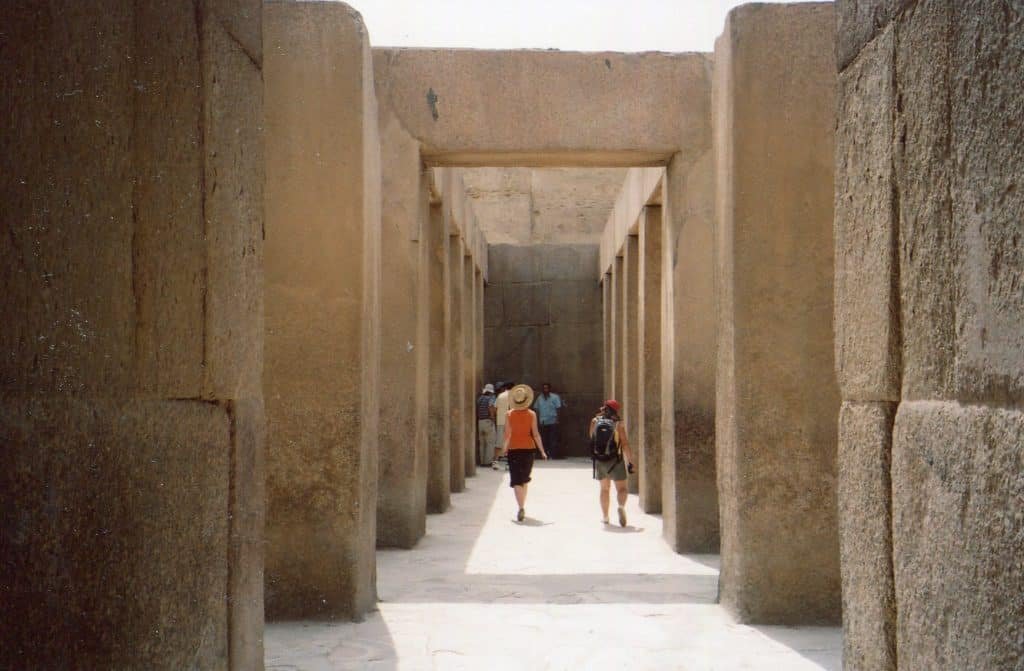
The above photo looks towards Khafre’s pyramid. The Sphinx is to the right. The valley temple’s two main rooms form a T, and the bottom of the body faces the pyramid. So I’m standing in the middle of the crossbar. The prior picture looks askance within the body.
The body’s aesthetics are very linear, simple, and stately. As ancient Egyptians developed their temple architecture, they did it in terms that reflected the Nile’s flow and the pyramids. They didn’t go for the abundance in Indian art.
Mark Lehner wrote that 23 statues of Khafre presided in pits in the crossbar and that they might have formed a cosmic circuit. The pit at the center of the leg is wider than the others, and he thinks that its statue might have been counted twice. He wonders whether each statue was honored at a certain hour or if a deified part of the royal body presided in each statue. In either way, a procession through the crossbar had the same grand linear quality as the body. Both rooms have a lot of gravitas, and they’re well worth lingering in.
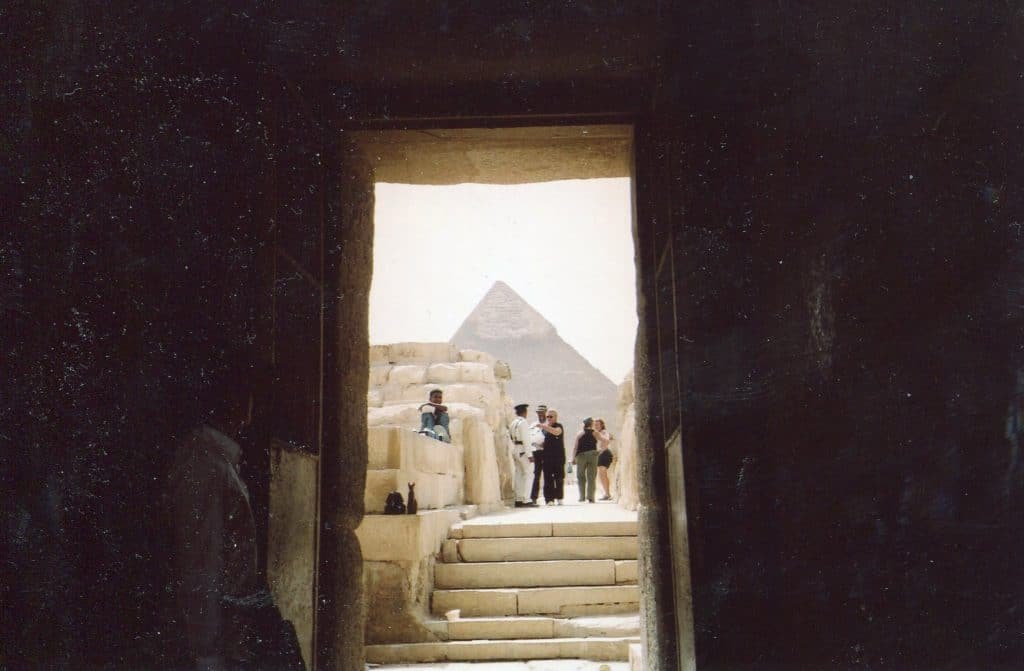
2. After paying my respects, I exited through the door that faces Khafre’s pyramid. The Sphinx and the Sphinx’s temple are just to the right. The temple is not nearly as well preserved as the valley temple, and it wasn’t open when I was there. It had two sanctuaries, one in the east (facing the Nile) and one in the west (towards the pyramid). Lehner wrote that both were associated with the rising and setting sun.
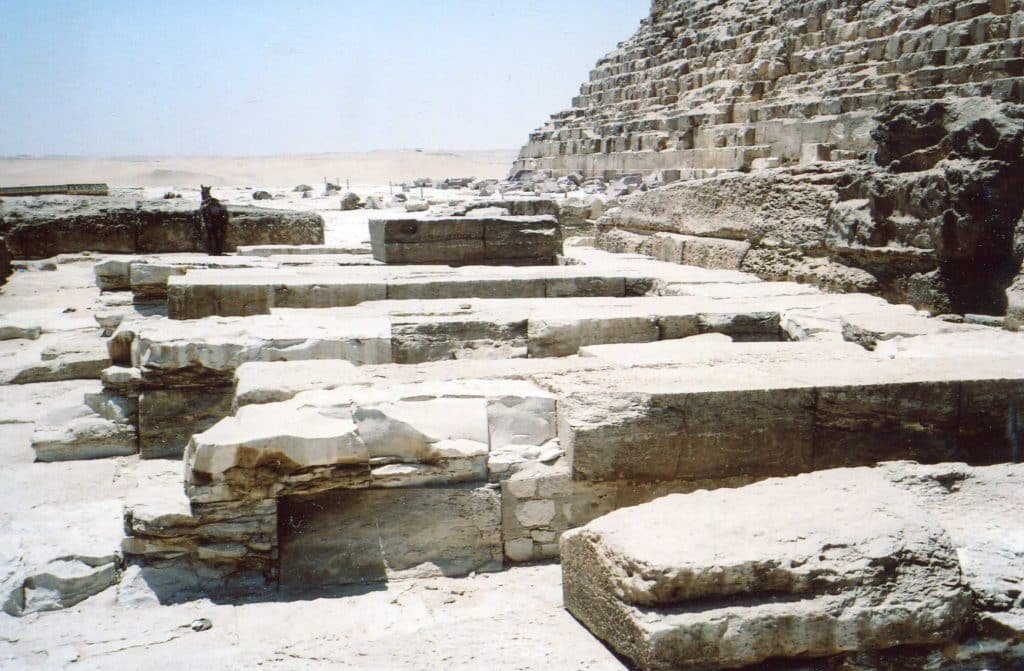
3. The third temple is above. It’s the mortuary temple, at the base of Khafre’s pyramid. It begins with a similar T configuration as the valley temple’s. Then there’s an open court, and beyond it is the back room, with five large niches (which is where I’m standing in the above shot).
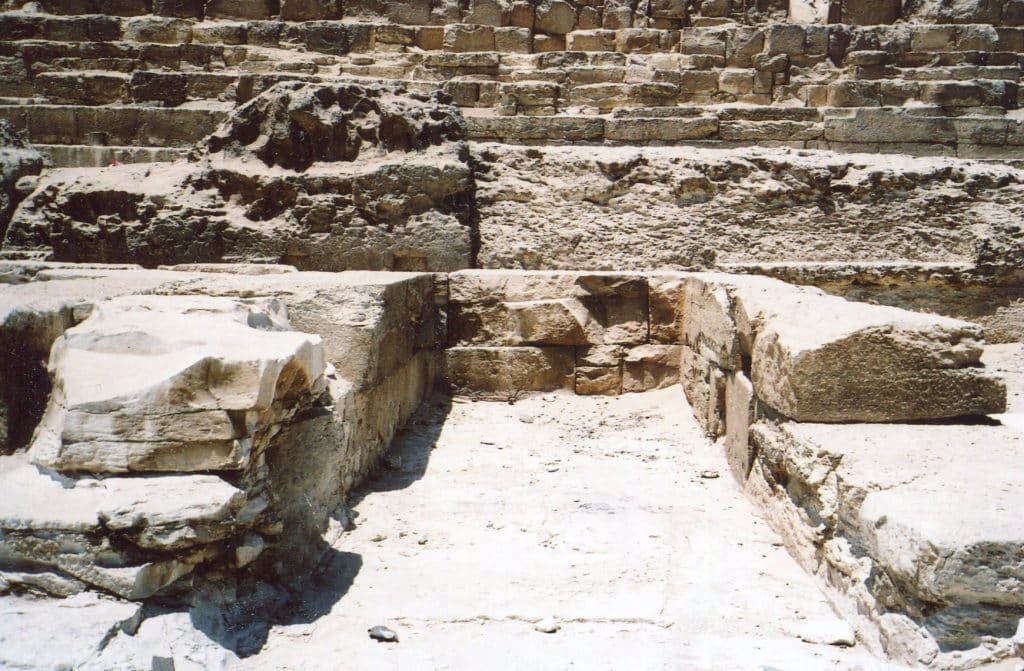
I’m in the same room in the above photo, facing a niche and looking towards the pyramid towering over me. This was the first temple to have five main features that later mortuary temples had. I already walked through the first three: the entrance hall (the T shaped room in this case), the open court, and now this room with the niches. Behind the niches are storage rooms and an inner sanctuary.
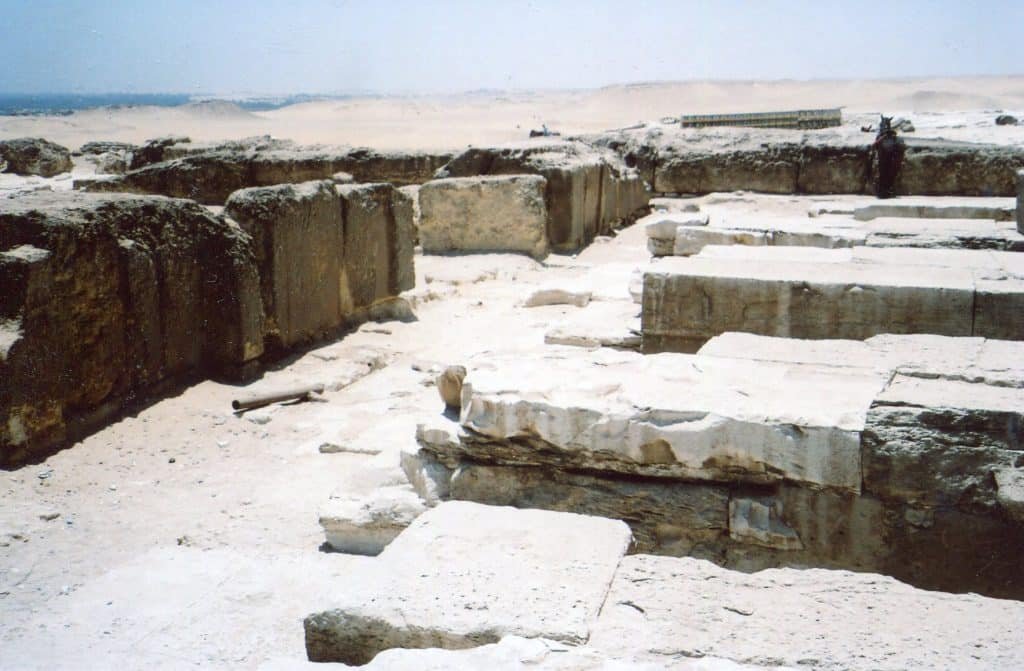
Above, is another photo from the same room with the niches.
So all three temples combine linearity and majesty. They’re all oriented to the rising and setting sun and to the pyramid’s direction from the Nile (to the west of the Nile, where the first two temples are)–where the Pharaoh attained eternity and ensured Egypt’s eternal well-being.
The pyramids alone expressed this network of ideas, but the new temples expressed it horizontally–the dimension in which people walked and offered libations, incense, and hymns to statues. Ancient Egyptians were creating more humanized art. They were also doing that with their literature, which we’ll examine in a future article.
The entire pyramid-temple complex that Khafre built forms a unified system, as Khufu’s Great Pyramid next door does. Both together created new perspectives as people saw them contrast with each other and viewed their parallaxes as they walked around them. This helped Egyptian intellectual horizons expand into a more dynamic world, which we’ll explore in the next two articles.