
Ancient Egypt’s King Khufu had a tough act to follow. His father, Sneferu, founded the Fourth Dynasty (2575-2465 BCE) and assembled more stone mass in his building projects than any other king in Egypt’s history–he constructed the Bent Pyramid and the Red Pyramid, both at Dahshur. How could the son top his father?
By perfecting what Sneferu had done. Khufu built on the trial-and-error construction experience in Sneferu’s reign and created a model of perfection that has yet to be surpassed.
Khufu began by selecting Giza as his burial site. Sneferu had chosen Dahshur, so Khufu founded his own estate for the afterlife. Here are some things that made Giza a perfect place to build one of the greatest monuments in world history:
1. The Giza Plateau is a limestone plate that rises above the Nile, so it was more visible from the capital at Memphis, and it presided over the city like an eternal royal palace.

2. It’s on the west bank of the Nile, like the earlier sites of Dahshur and Saqqara. West was associated with the afterlife, where the sun sets.

3. The Giza Plateau has a regular surface which is less than a square mile. It’s a perfect frame for a building project that would rule Memphis forever.
4. You can see the pyramids of Giza from Saqqara. I found this to be Giza’s most impressive feature. The pyramids at these sites were visible from each other. Each king wasn’t seen as entirely distinct, but as part of a dynastic line. Considering that the pyramids stood out like a row of mountains, people might have thought that all their powers added up as the bastion of order for the state. All together ensured a well-run state and universe, and they inspired awe that we can barely imagine today.
5. Giza is also within sight of Heliopolis. This is where the cult of the sun god Re was based, and he became the central deity in the Fourth Dynasty. Giza is north of Saqqara and Dahshur. Heliopolis is a little north of Giza, and on the east bank of the Nile. Giza thus helped integrate all the sites that pharaohs had built pyramids on with each other and with Re’s cult.
So Khufu couldn’t have chosen a better place for a building that would stand out like the glorious sun itself and which would be a model for the permanent geometric forms and ratios that the West would venerate and also create in ancient Greek temples. What a contrast with the love of abundant forms in much of India’s art. Egyptians and Greeks usually liked to pare things to their clearest and simplest forms.
The Great Pyramid towers 450 feet over the Giza Plateau. It was originally encased in limestone, which increased its height to about 480 feet. The limestone made the building reflect the sun and appear like a ray. The builders of Cairo in the Middle Ages quarried the casing to construct palaces and mosques.
It rises at a 52 degree angle. The last pyramid that had been built, the Red Pyramid, rises to 345 feet at a roughly 44-degree angle. Khufu’s Great Pyramid perfected the form that his father, Sneferu, created.
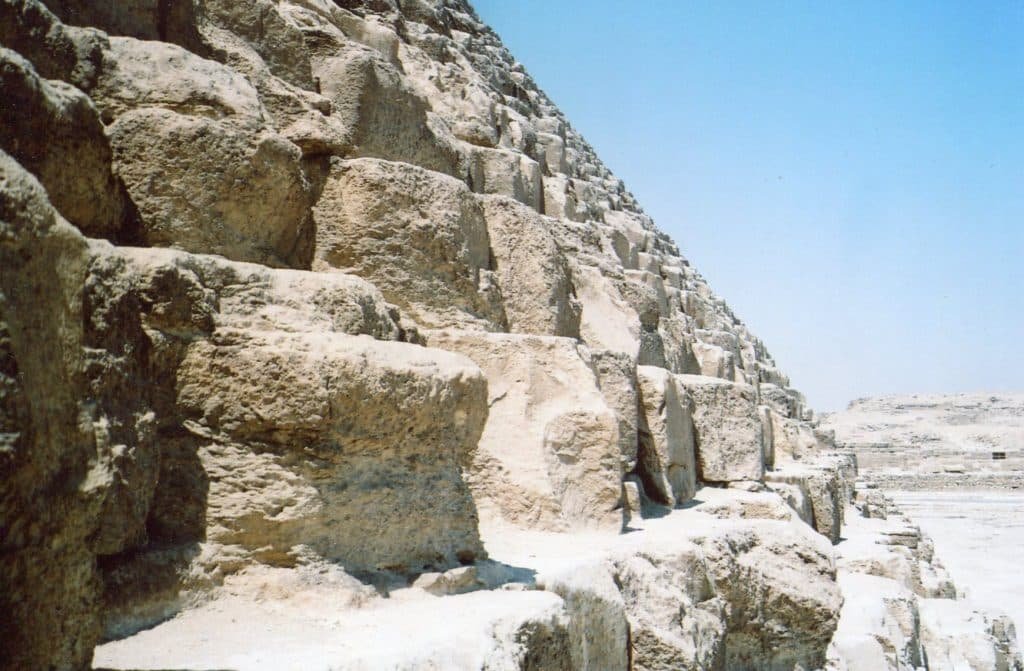
Khufu’s builders learned from the mistakes Sneferu’s workers made while constructing the Bent Pyramid at Dahshur. They had a more stable foundation at Giza and used larger blocks, which they placed more closely together. The Great Pyramid contains about 2,300,000 stone blocks, which weigh an average of 2.5 tons. The foundation and the size and more accurate placements of the stones made the Great Pyramid stable enough to sustain the 52-degree angle.
The pyramid might have been built by erecting a straight ramp that approached the building from one side. Or a ramp might have wound around it as it was built. Mud spread on the ramp would have made pulling the stones somewhat easier.
Ancient accounts say that up to 100,000 people built the Great Pyramid and that they worked for three month periods between the growing seasons. Most thus might not have been permanent slaves, but ancient writings portrayed Khufu as a cruel despot. Did all those men with aching muscles and sweaty brows have faith that they were toiling for the cosmic order, or were they cursing under their breath? Different historians have held opposite ideas. Jan Assmann wrote that they held a common ideal of everyone being unified under the king, while Tony Williamson felt that most ancient Egyptians were heavily oppressed. But he noted things that might have made their lives more bearable, saying that the builders were probably organized into teams of 20 people, each with its own leader. This might have encouraged team spirit and friendly rivalries between teams. They were organized into larger units, including gangs of 1,000 workers. Some gangs gave themselves fun names, including “The King’s Drunkards.” This reminds me of the work-hard-play-hard ethos of industrial-age steel workers in Pittsburgh, construction workers in New York, and auto workers in Detroit.
We’ll now explore the pyramid’s interior.

I’m standing in front of the ancient and modern entrances. The big hole is the old entrance. The small one with the line of people is the one you use today. Here are some of the inside’s features:
1. The entrance leads you down a narrow corridor that descends at a 26-degree angle.
2. You come to a fork, with one passage continuing through the rest of the pyramid and then down through the natural rock at the same angle. It ends at a chamber carved from the rock. It’s incomplete, and a narrow passage leads south from one corner. It thus probably wasn’t meant to be the king’s burial room, because his chamber was supposed to be the last one you come to. This underground room remains a mystery.
3. The second passage is the one you use today. It rises at about 30 degrees. It’s only 3 1/2 feet wide and about 4 1/2 feet tall, and is thus a bit difficult to ascend.
4. You come to another fork. One passage is level, and it leads to the second of the three rooms in the pyramid. It used to be called the queen’s chamber, but the name is misleading–Khufu’s queens had their own pyramids, which were much smaller. A small niche is in the wall. Because this room is under the king’s chamber and because it was totally closed off, it might have been used for the king’s ka. This was the component of the soul that energized it.
5. The second passage is called the grand gallery, and entering it is a sublime experience. Here the cramped passageway widens to about 6 1/2 feet and soars to 26 feet, with a corbeled roof like the ones in the Red Pyramid. It’s more than 150 feet long, and it ascends at the same angle. Sadly, a guard at the pyramid’s entrance made everyone leave their cameras with him. This final approach to the king’s chamber is monumental.
6. The king’s chamber is a rectangle about 34 by 17 feet. High up in the pyramid, and presiding over the other two chambers, it’s close to the sun. This room is roofed by nine long granite lintels. They’re 18 feet long and vary between 25 and 40 tons. Egyptians had never spanned such a large space in stone before. A granite sarcophagus presides at the far end of the room. It was broken into in ancient times.
7. Narrow air shafts rise from this room and from the “queen’s chamber” and extend through the pyramid. They’re oriented to circumpolar stars, so the king’s soul is supposed to have risen through them to join these permanent celestial beings in their nightly journeys.
So the Great Pyramid was used to transform the king’s soul into eternity and allow it to both rise with the sun during the day and join the stars at night.
But the Great Pyramid at Giza also had other aspects. It’s more than a pyramid. King Khufu constructed many other buildings at his burial site which added more meanings to it.

You can appreciate Giza much more by exploring the buildings around the Great Pyramid.
A stone causeway almost half a mile long led from the Nile to the pyramid’s east side. The fifth-century BCE Greek historian, Herodotus, said that its walls were carved with reliefs. It ended at a large stone mortuary temple with an open courtyard and storage rooms. This was the first large stone temple in Egypt.
A 26-foot-high limestone wall surrounded the rest of the Great Pyramid. Access to the pyramid was only through the temple.
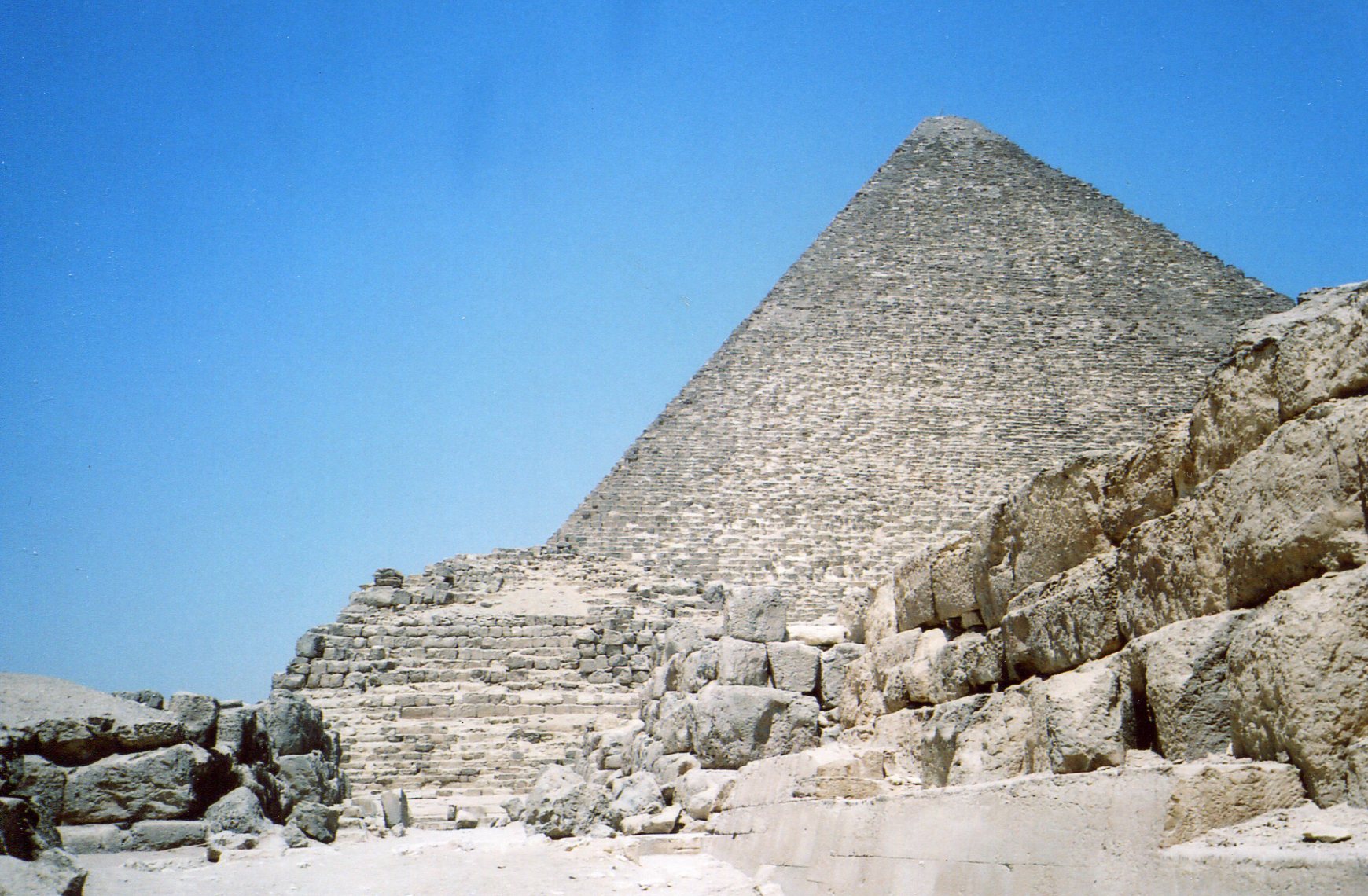
Three pyramids were built along the east side, two for queens and one for Khufu’s mother. You can see one in the above photo.
Two boat pits flanked the mortuary temple. One was excavated and the remains of a 142-foot-long boat were found and reassembled.

Several rows of tombs in the form of mastabas (single-level rectangular blocks) line the Great Pyramid’s east and west sides. They were used for high-ranking officials and other members of the royal family. As the above picture shows, they were built in neat rows, like streets of a modern city.
So Khufu imagined Giza, not just as the Great Pyramid, but an entire society that included his family and high-level administrators. The order that unified the civilized world was thus given eternal life. It could be seen from Memphis, Heliopolis, and the older sites at Dahshur and Saqqara. It’s awesome enough today, but it must have seemed like the center of political, religious, and cosmic order.