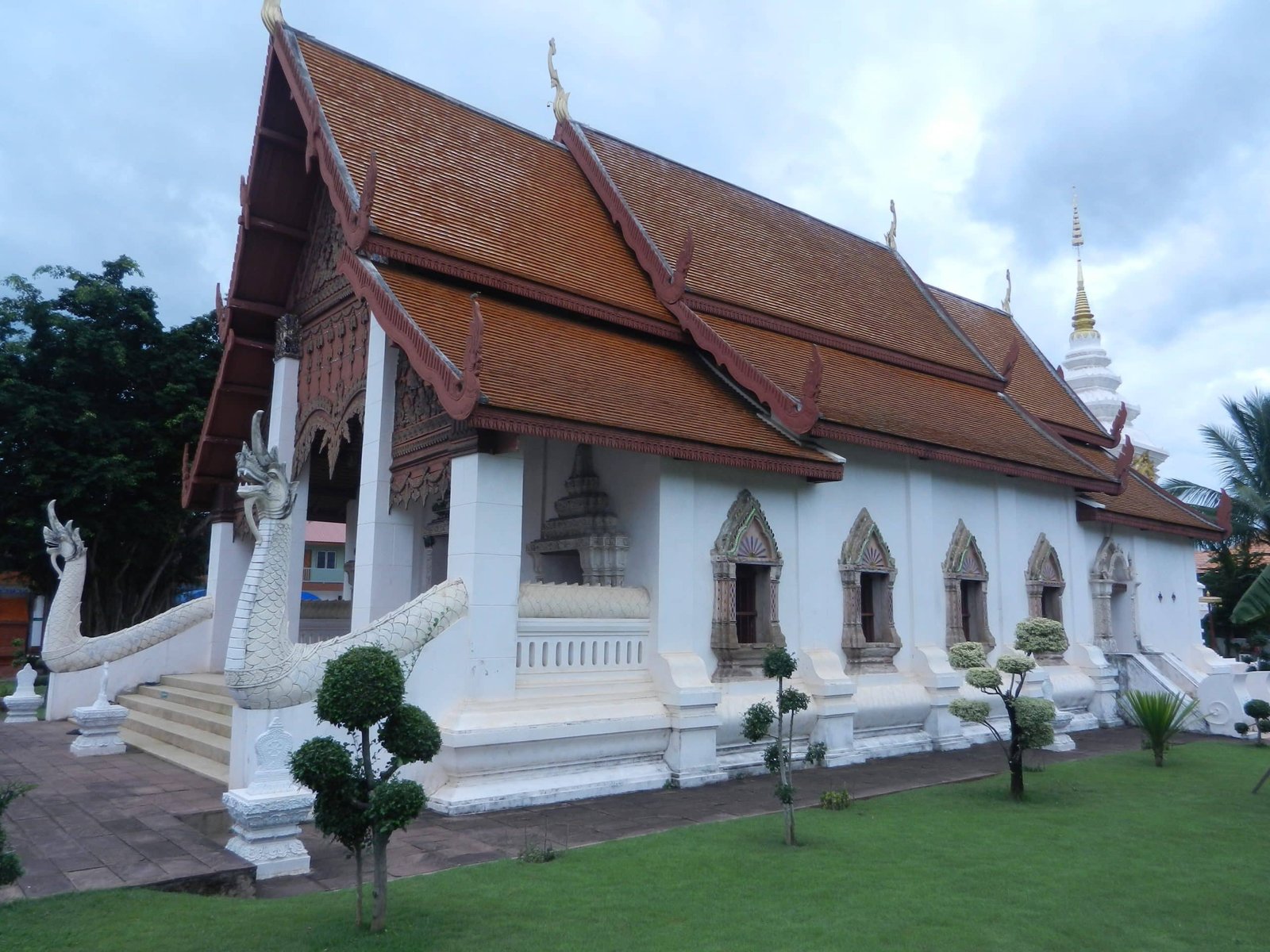
“All Lan Na wats are beautiful.” I agreed with the gentleman in Nan who told me this (Nan is a historic city that thrived within the northern Thai kingdom of Lan Na in the 15th and early 16th century). And each wat is unique.

But northern Thai wats have common features that make them many people’s favorites. I met several locals who prefer northern Thailand to the south, and I encountered many Westerners who decided to move there. Come and explore some of northern Thailand’s magic.
Northern Thai wats are known for their human scales–no Angkor Wat -sized behemoths here. The vihara (public assembly hall) of Wat Hua Khuang has the sinuous forms that you’d expect in Thai art, but it’s small and cozy.
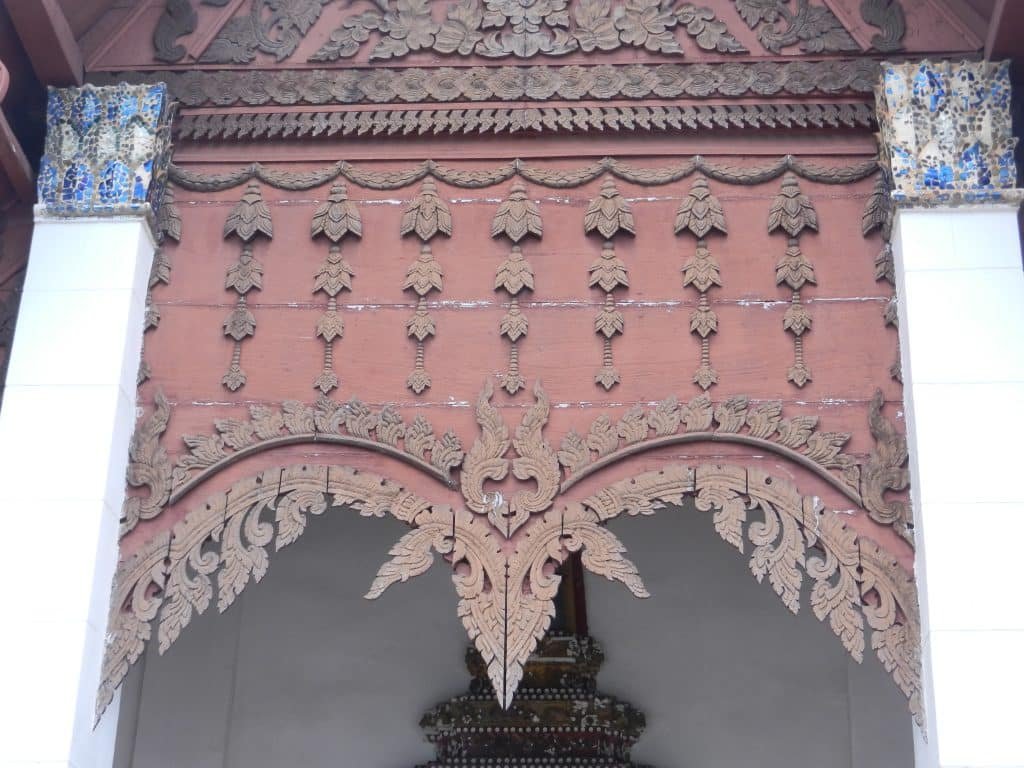
Above, you can see a detail of the board over the entrance. The wing shape’s common in northern Thai wats; it represents the Buddha’s eyebrows. The carved bunches of flowers hanging straight down add an extra gentle and elegant touch to this humanized form to invite people to come inside.
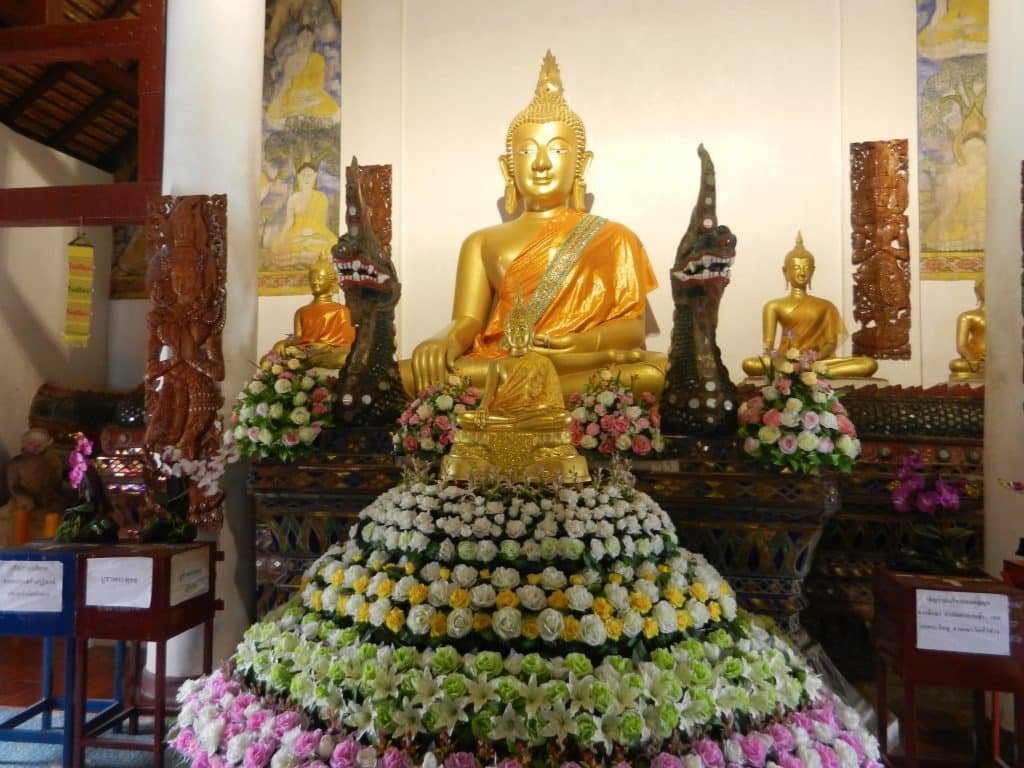
Graceful chemistry takes place when you step inside a vihara. The altar with the main Buddha statue stands at the opposite end, but people’s gazes aren’t forced towards this figure. Most of the hundreds of wats that I explored in Thailand with an operating meditation hall have several Buddha statues on the altar. There is always a main figure, which is usually the largest and placed in the center, but many other statues surround it. Their sinuous forms and golden surfaces mingled into a slow flow as I strolled around them. Being close together, their forms and glowing hues reflected each other, and the view gently shifted as I moved. It was different every few seconds and always beautiful. The statues didn’t stand out as distinct objects that are most fundamentally characterized by abstract lines and points. Instead, they seemed like participants in a genial stream of benevolent energy. The multitude of Buddha statues in the vihara of another wat in Nan (below)–
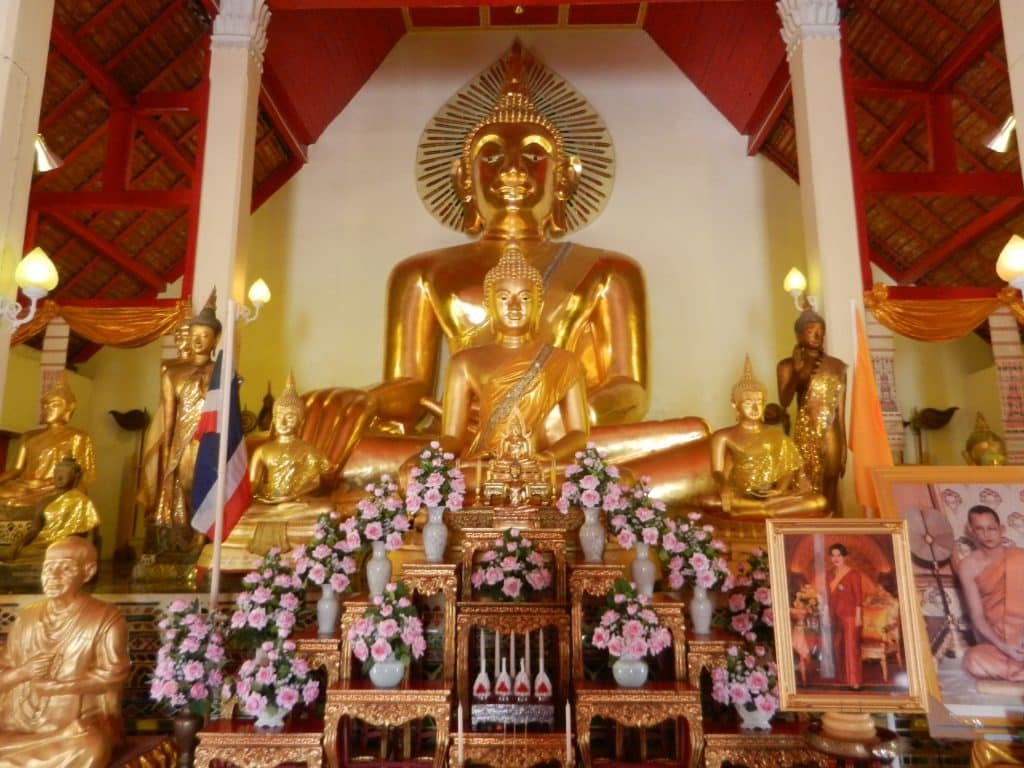
–shine on each other and on their surroundings as you stroll around them.
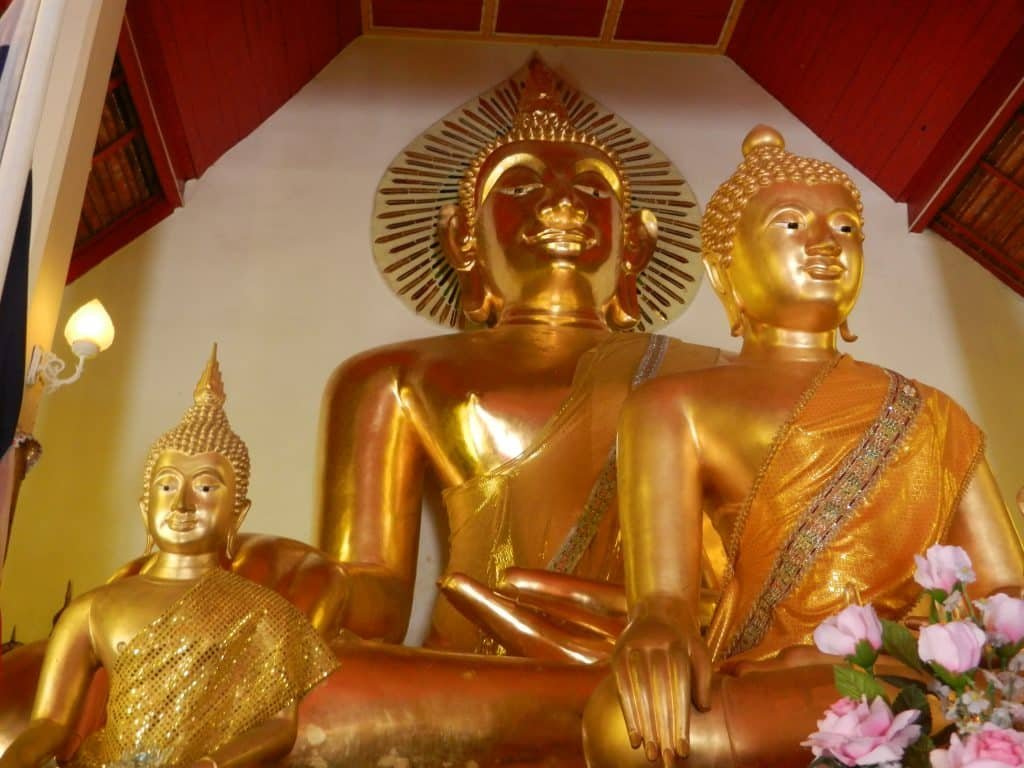
Many other things usually surround the altar. Flowers, incense sticks, banners with brightly painted animals, a pulpit carved in floral patterns, and pictures of the royal family blend with the Buddha statues into a profusion of forms and colors which cannot be reduced to a single vantage point. They make the surroundings appear animated, but their elegance and the slow walking seem to render them kind. They allow an endless variety of perspectives to thrive. All coexist under the Buddha’s compassion.
His compassion extends to the people sitting and ambling in the hall. They add to the multitude of slowly moving forms. The whole community seems immersed in his sweet energies.
If you’re in a Thai temple, please walk around at a slow pace and then sit for a few minutes. Watch people come and go and enjoy their civility. Stroll a bit more until you find another appealing spot and savor it. Repeat this as long as it makes you happy. For traditional Thais, the world largely hangs together in this easygoing flow of forms, colors, and people.
Thais are more comfortable with a universe that’s on a human scale than the vast cosmos from Indian traditions. And they’re more at home with a multitude of shapes that bend and colors that flicker than the rationalized classical proportions in the West. Wat Hua Khuang perfectly blends them (below).
The universe full of abundant energies is brought down to our size so the community can happily live in it.
Abundant energies in nature and the cozy community–these seem like contrary ideas, but they have shaped thought in Thai and most other Southeast Asian societies since they formed communities along rivers thousands of years ago. So Thais became experts at integrating both senses of the world in their art. They can mesh in limitless ways, and there’s no end to the perspectives you can have of an art work. Keep exploring a temple and you’ll always find new ways to enjoy it.
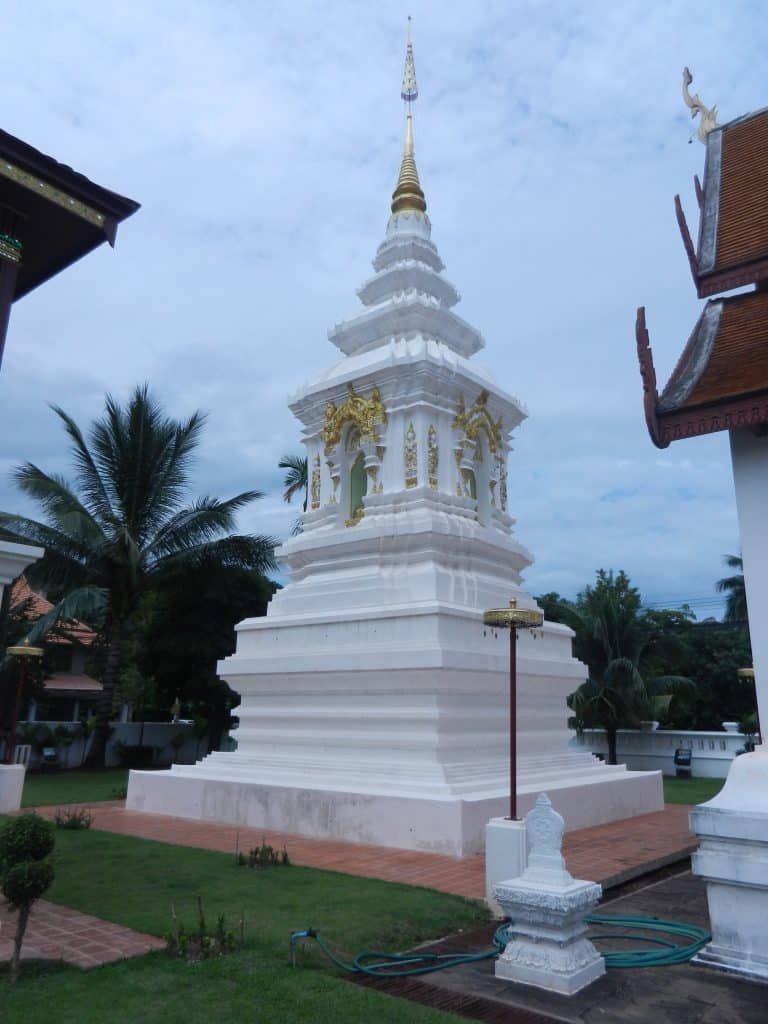
Perspective in Thai art doesn’t assume to give one all-encompassing view of the whole shebang. Temples do have centers–the main Buddha statue and the stupa, (Wat Hua Khuang’s is in the above photo) are the most revered places. But their forms aren’t strict, like the three-dimensional perspective that developed in Florence in the 15th century. They’re gentle and rippling. These monuments rule, but benevolently. They allow magic to emerge in their surroundings.
Wat Hua Khuang’s stupa’s form (above and below) is very soft.
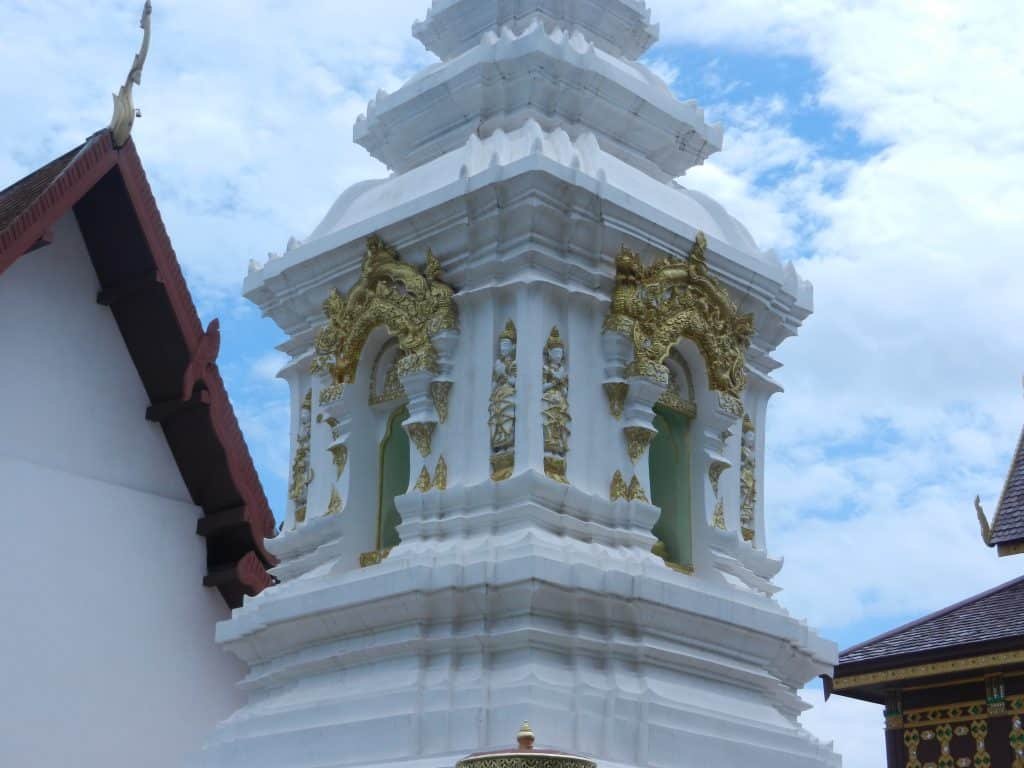
The stupa symbolizes the three-worlds cosmology that Thai Buddhism adopted from Sri Lanka and India. The bottom represents earth, the middle (shown above) represents the heavens, and the top is the realm beyond all forms. Thais often took this vast conception and made it graceful. Like many Thai stupas, Wat Hua Khuang’s doesn’t impose on anything. Its lilting forms play and dance. This lightness allows other buildings to shine.
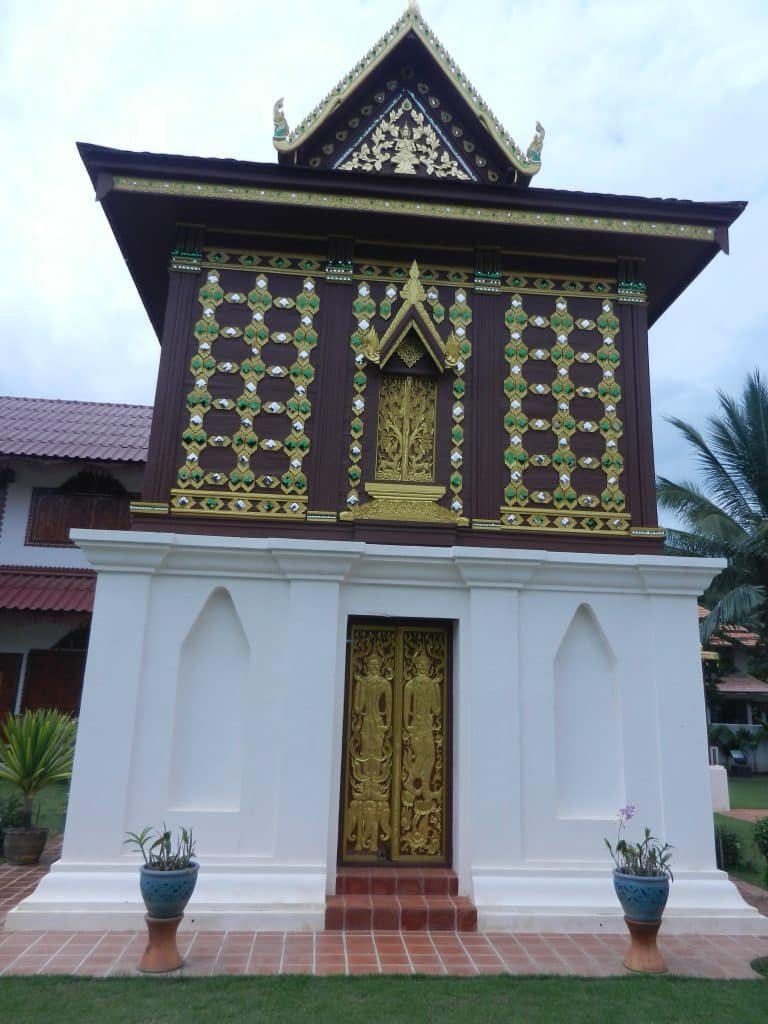
The above building is called the ho trai. Monks store scriptures in them. But Wat Hua Khuang’s doesn’t have the gravity that you’d expect from a building where sacred books preside.
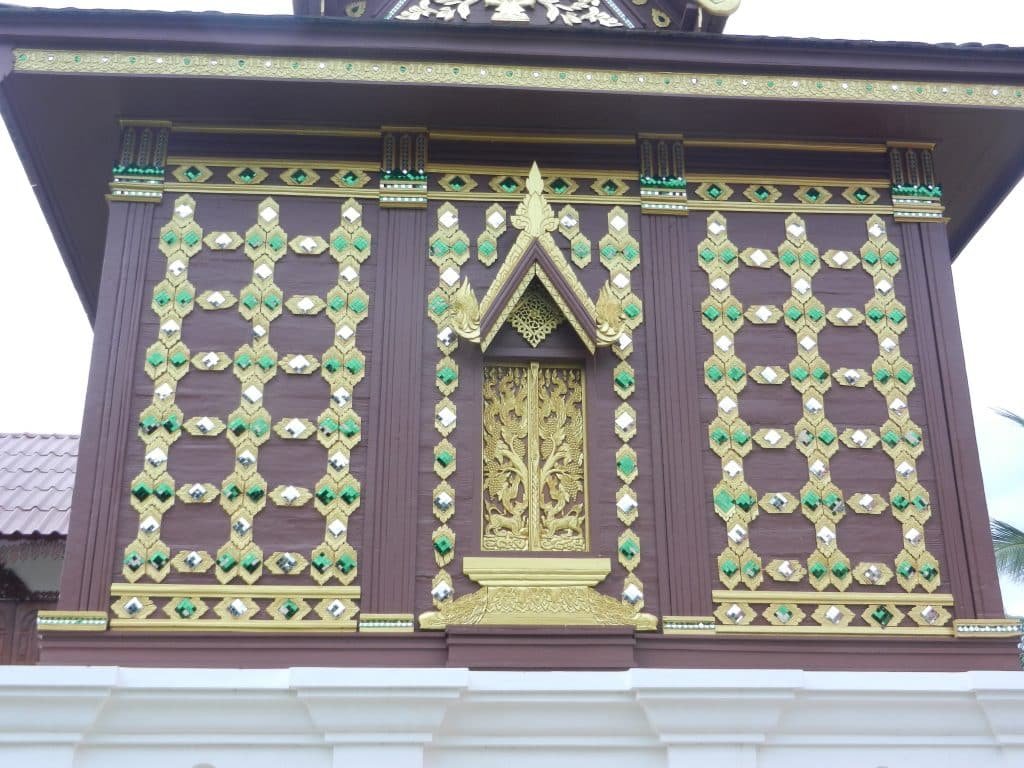
The ho trai’s glimmering golds and greens stand out from the dark teak wood. The bright and earthy colors balance each other. But my favorite thing about Wat Hua Khuang’s exterior is–
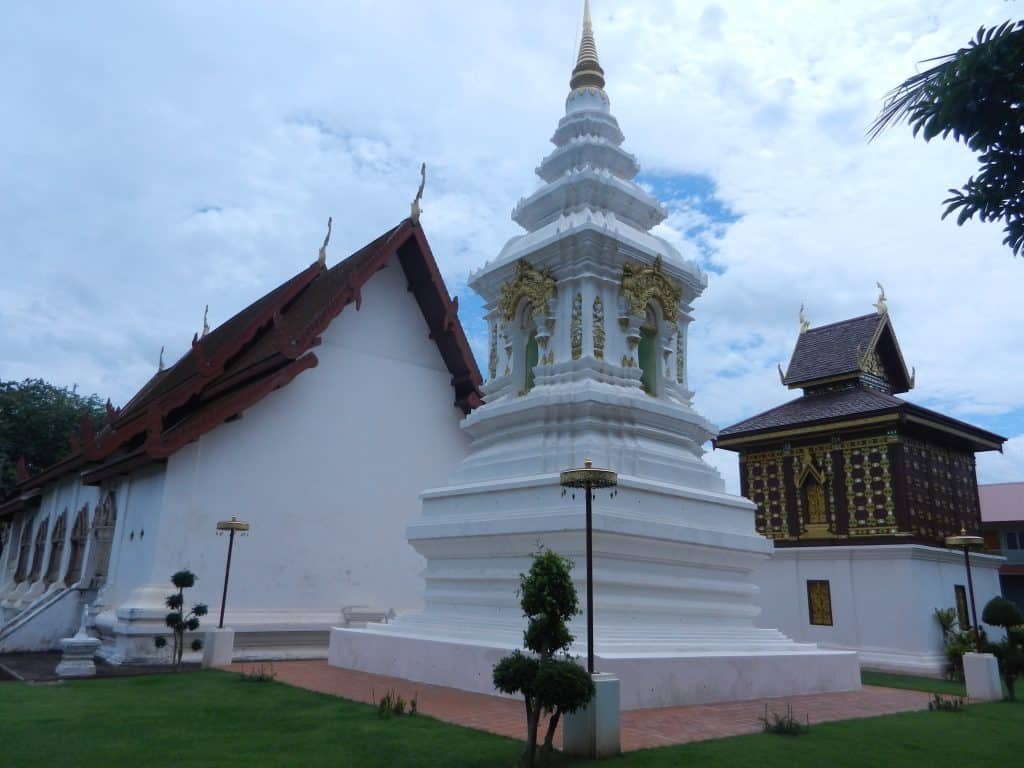
–all the buildings complement each other. They all allow each other space.
And they give you space to amble and enjoy them from many places. They’re centers of perspective, but they allow limitless vantage points. All are given room. The world, with its multitude of life-forms, is in balance.
And some interesting spirits live in this world.
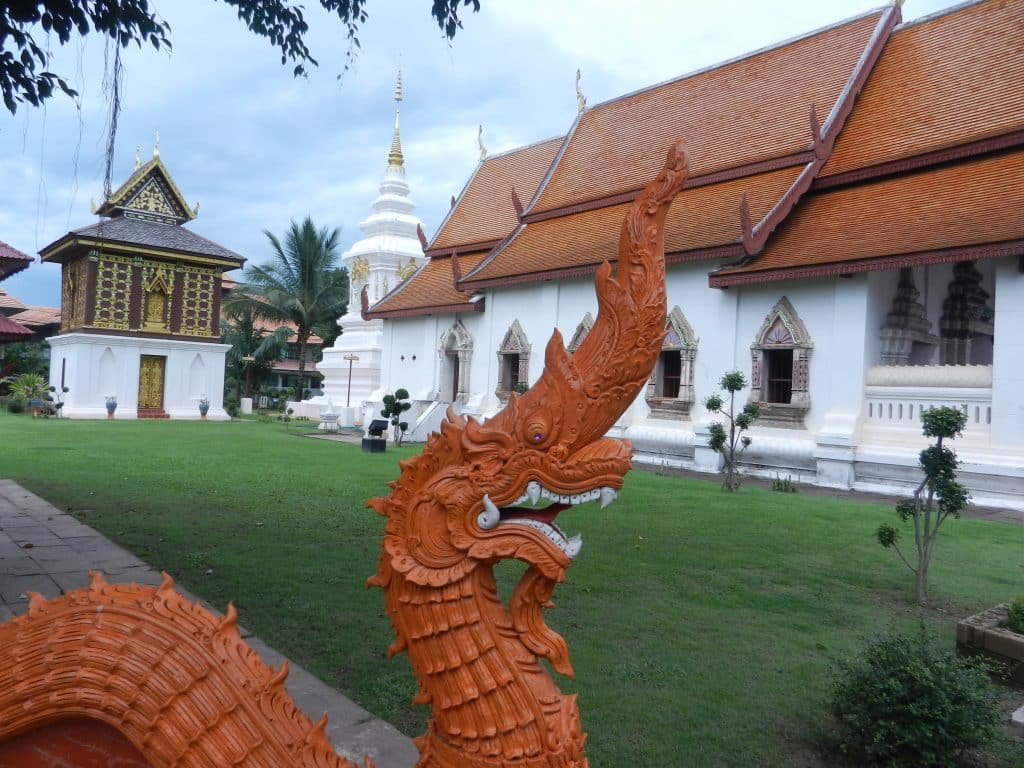
Thai temples allow many spirits to coexist, and lots of spirits roam in Southeast Asia’s abundant natural landscape. So every Thai temple has a spooky side. The naga who rears his head in the above shot defends the temple against the many hungry ghosts and bad-tempered nature spirits in the neighborhood.
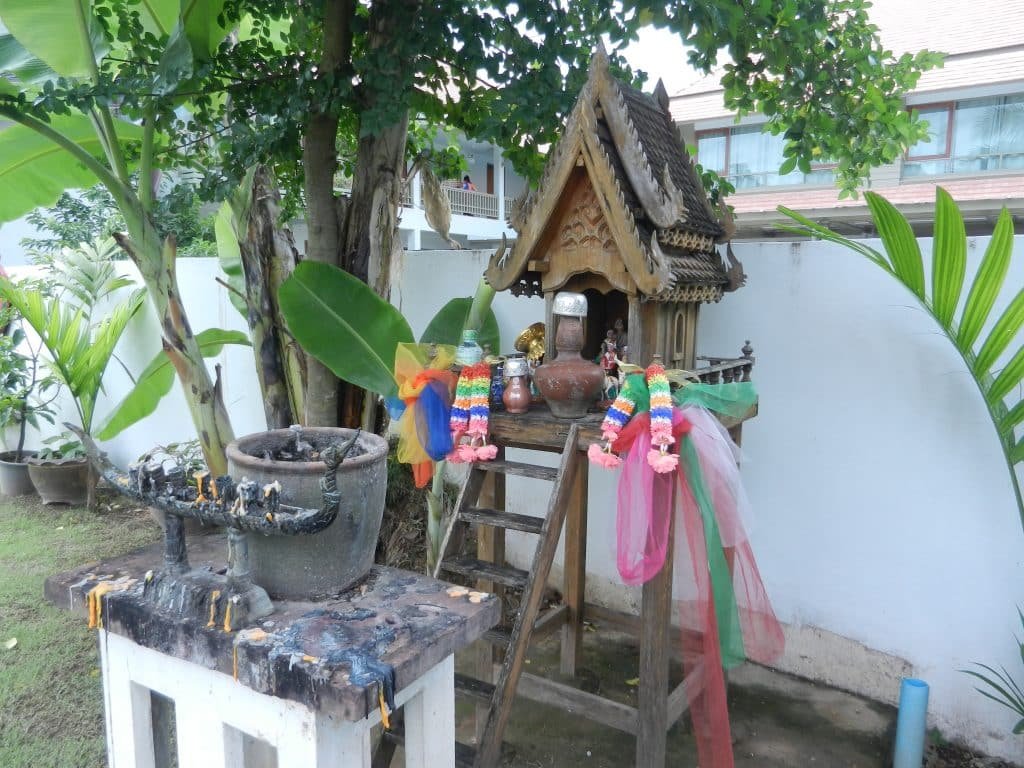
Thais believe that a building’s land has a spirit. Wats are no exceptions. The spirit represents the land’s power to generate life, so it must be respected.
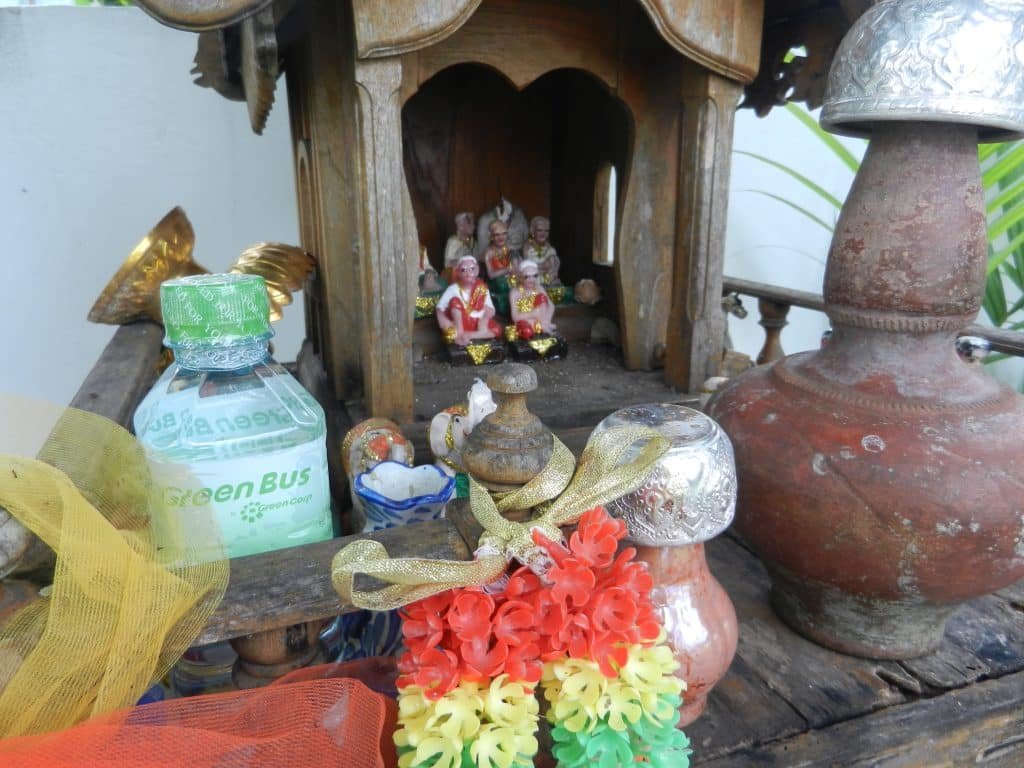
The people at Wat Hua Khuang put little statues of followers of the Buddha inside the spirit house, and they also follow the ancient practice of offering daily provisions.
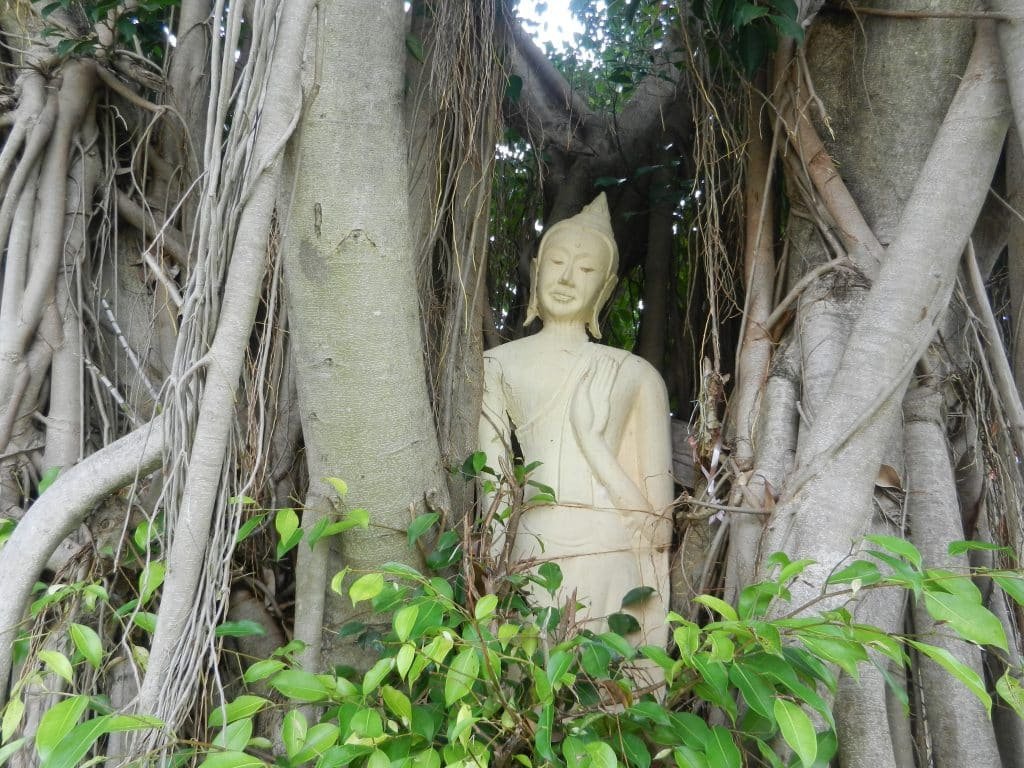
Trees also have spirits, and folks must respect them too.
A Thai wat houses enough ghostly creatures to give Hitchcock fans the shivers. But Thais add their own culture’s forms to them to make them tame enough to live with.
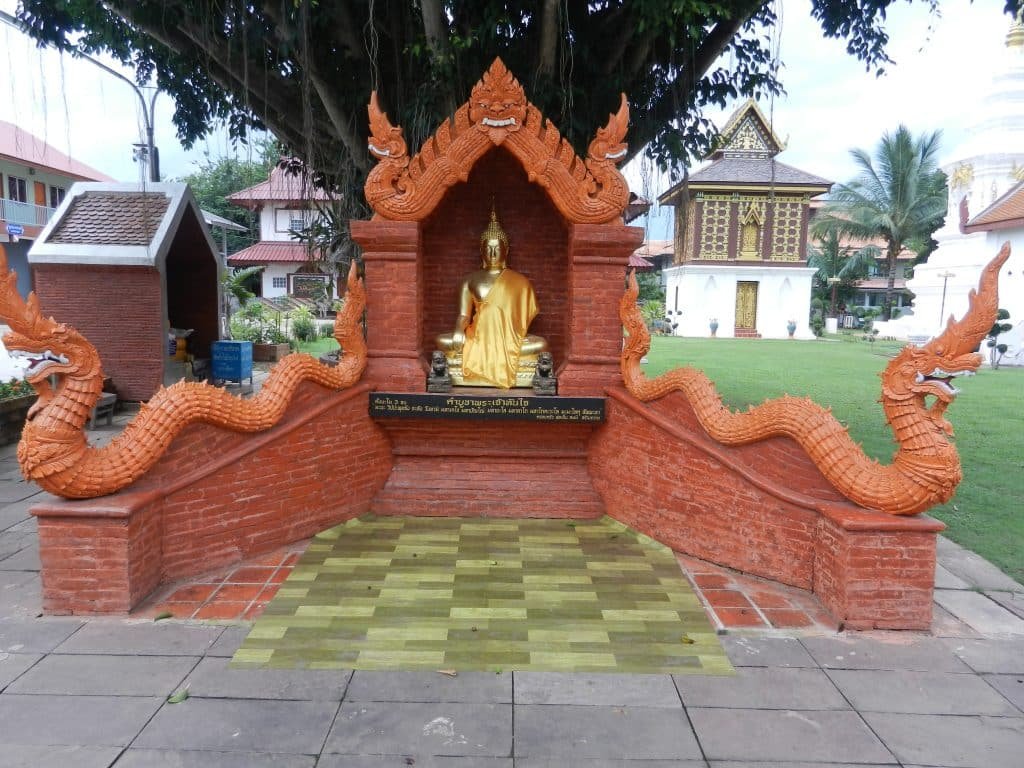
The nagas in the above photo aren’t nasty although they look fierce. They’re guarding the Buddha. The four nagas’ bodies frame his golden glow with sinuous lines that are elegant as well as potent.
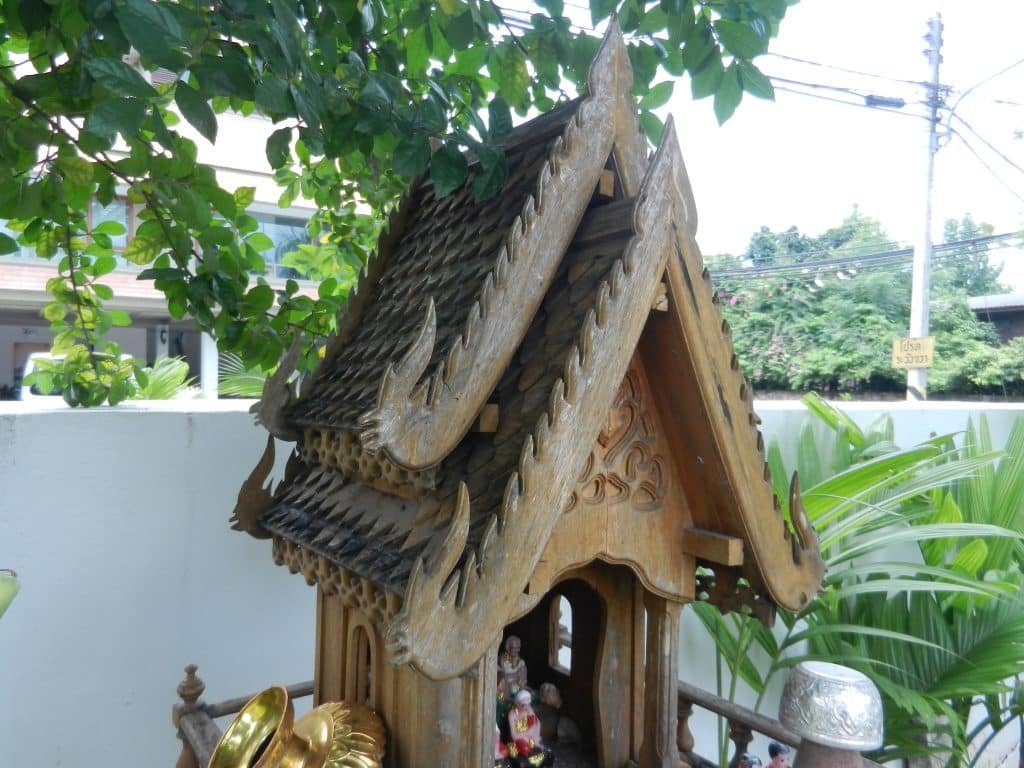
The spirit house sports the same forms that the vihara does–they lilt, rather than impose.
Thai perspective doesn’t impose one order of things too harshly. But Thais have lived in tropical lands’ profuse growth since ancient times; imaginations can cook up lots of bogeys where nature’s powers seem overwhelming. If you wander too far outside the order of things, you could expose yourself to dangers.
Graceful forms and polite behavior (like giving the land’s spirit offerings) provide the solutions. Many spirits share the abundant landscape, so Thais stress harmony more than conflict. Everybody has a place in a Thai wat, and the beautiful art-forms keep everyone happy. Perspectives in wats aren’t linear; not everything is immediately revealed in one line of sight. There are always more aspects of the environment to discover, and all are balanced with each other. I think this is a great ideal for today’s world.