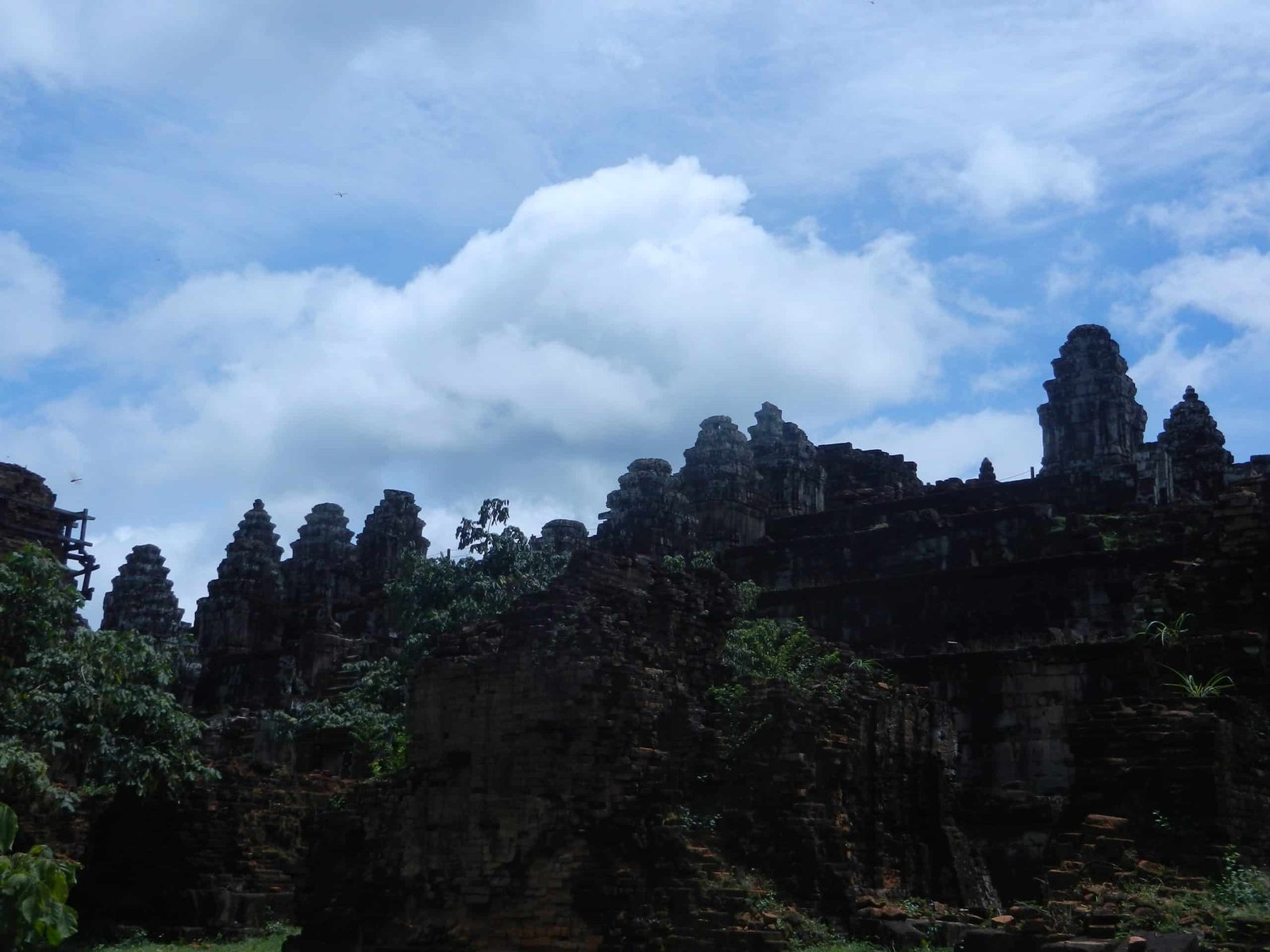
The Khmer king Yasovarman I (r. 889 CE-about 910) was both conservative and radical.
He succeeded his father, Indravarman I. I detailed the former’s monuments, The Bakong and Preah Ko in prior articles. Yasovarman would outdo him by moving the capital and founding the city that later kings built Angkor Wat and other huge temples in.
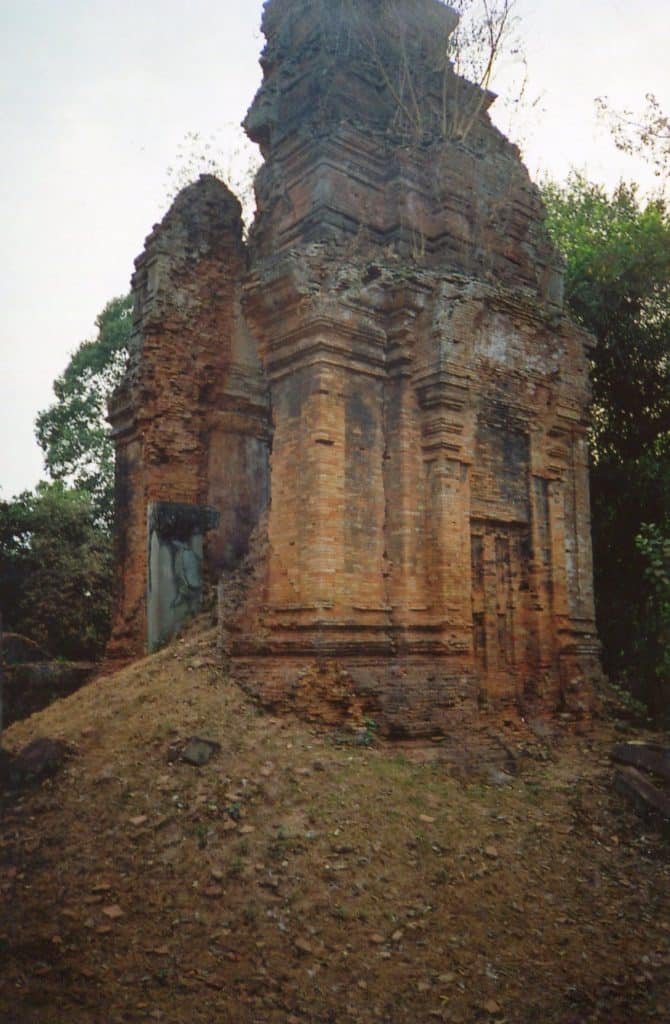
But before creating something greater than Khmers had ever seen, he paid homage to his father by building a beautiful temple that’s now called Lolei (you can see one of its four towers in the above photo).
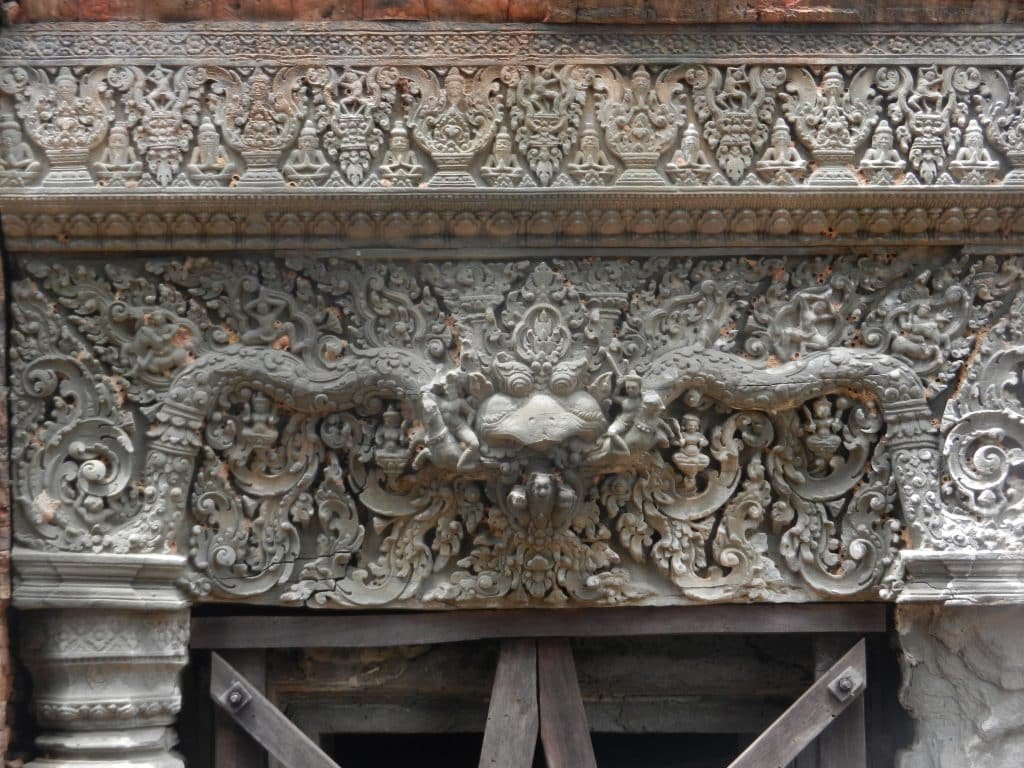
Its elegant door lintels easily match Preah Ko’s.
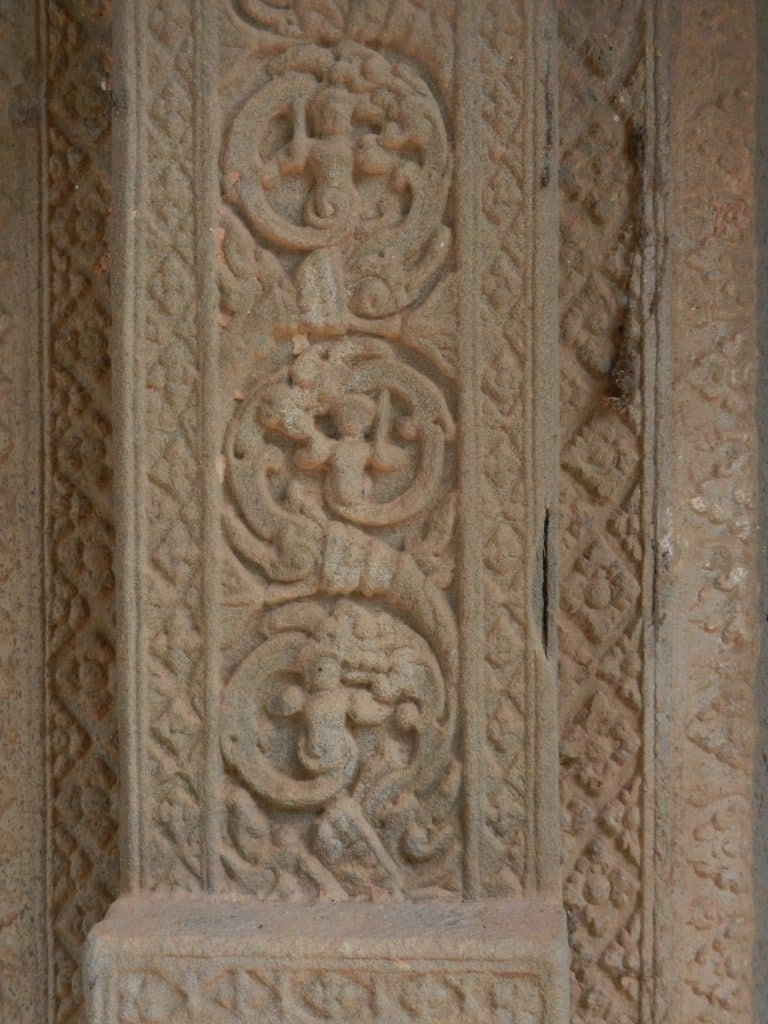
False stone doors contain vibrant vegetal patterns that envelop human figures. Ancient Khmers loved exuberant designs that reflected the jungle’s vitality.
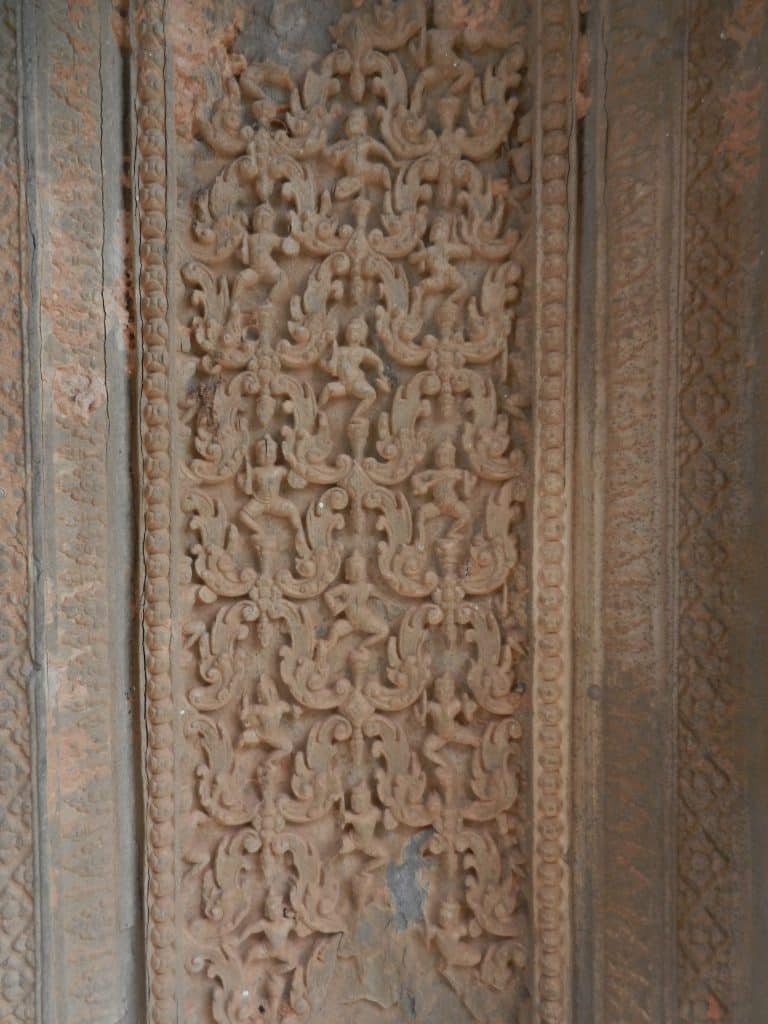
Lolei was an ancestral temple, like Preah Ko, and it has some of its features. Yasovarman dedicated it in 893 to Shiva–the same god that Preah Ko honored. Lolei has four brick towers lined in two rows, and they were built on a common platform. Preah Ko has a similar configuration, though it’s more complex.
Though Lolei is simpler than Indravarman’s ancestral temple, it matches it in beauty. Yasovarman constructed it on an island in the reservoir (baray) that his father dug. This was the first huge baray that the Khmers built, so it stood out all the more then. So Yasovarman built his homage to his ancestors in the middle of one of his father’s greatest constructions. The baray is dry today, but Lolei’s elegant little towers once sparkled like jewels in the limpid water.
Yasovarman must have felt satisfied with this tribute to the man who had been the Khmers’ most illustrious builder. He would now move on to construct grander monuments.
Yasovarman began by founding the city of Angkor. He did it in dramatic fashion.
Yasovarman named his new capital after himself, Yasodharapura. His ancestors had named the old Khmer capital at Rolous after a god, Harihara (half Shiva and half Vishnu). Yasovarman struggled with his brother, the crown prince, for the throne and vanquished him. This might have impelled him to establish a new capital and outdo the past.
He built a heck of a spread. It was enclosed in an earth bank that was about two miles long on each side–larger than Angkor Thom, which was built over his city in the 13th century.
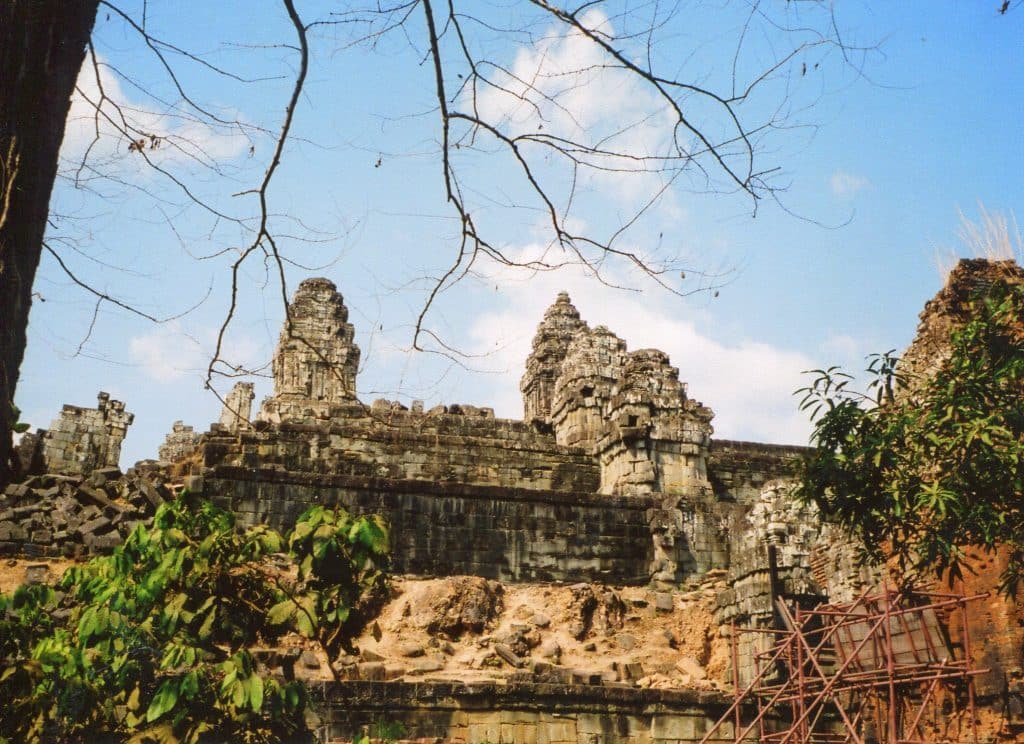
Though Yasovarman tried to outshine the past’s grandeur, he kept its roots by building the three types of great projects his father did. Yasovarman already constructed an ancestral temple. He now dug the biggest reservoir (baray) the Khmers had made so far. It extends more than four miles–longer than 20 ocean liners. People standing on its shore saw the water rippling towards a barely visible tree line. It must have seemed that only a god could have made it.
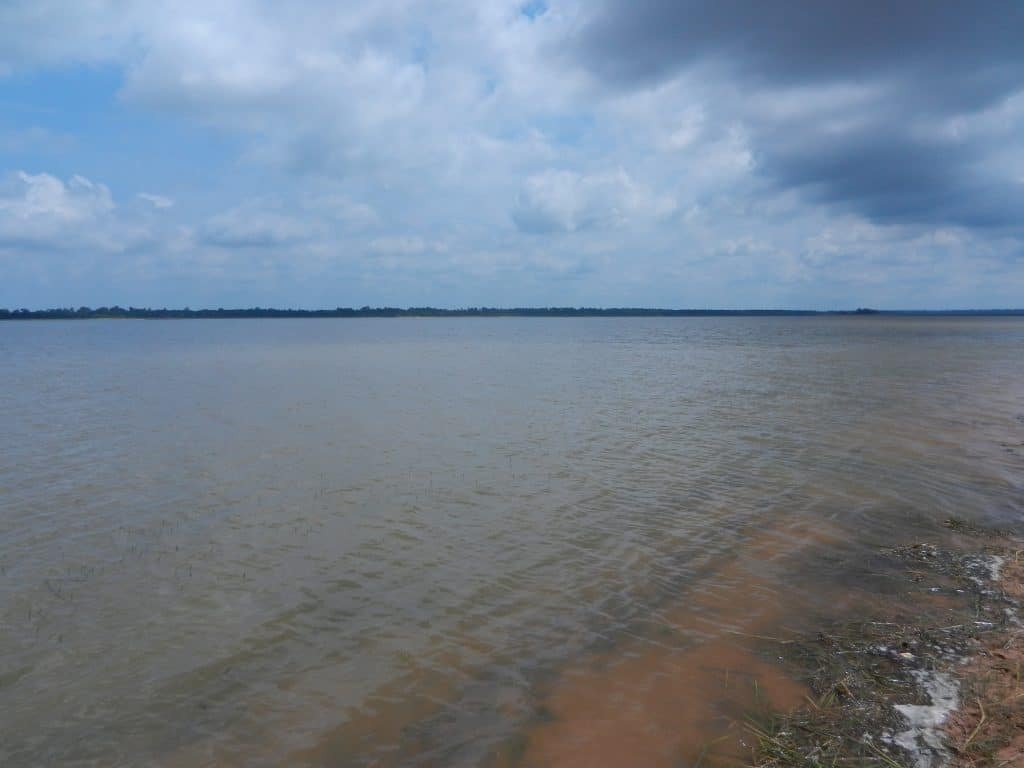
He then worked on the third great construction project, the state temple for the royal cult. This monument, Phnom Bakheng, became the centerpiece for Yasovarman’s new city.
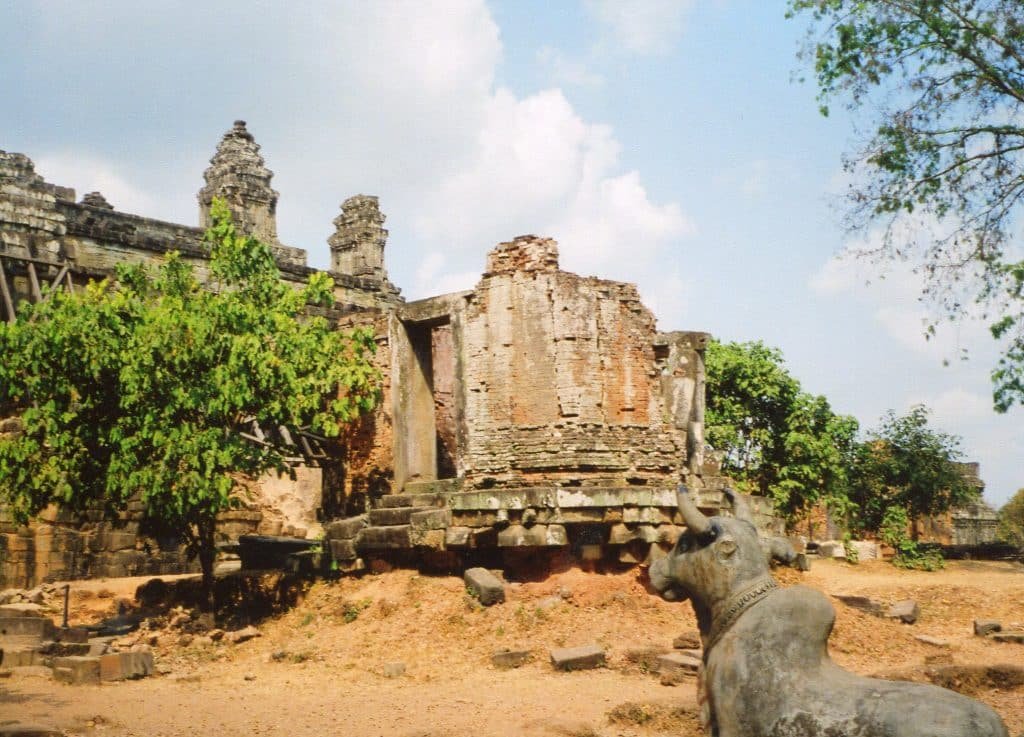
We can note some of Phnom Bakheng’s features:
1. Yasovarman followed some of his fathers traditions, which he put into his royal temple, The Bakong. Phnom Bakheng also honors Shiva (the bull you see respectfully looking up at the temple is Shiva’s mount).
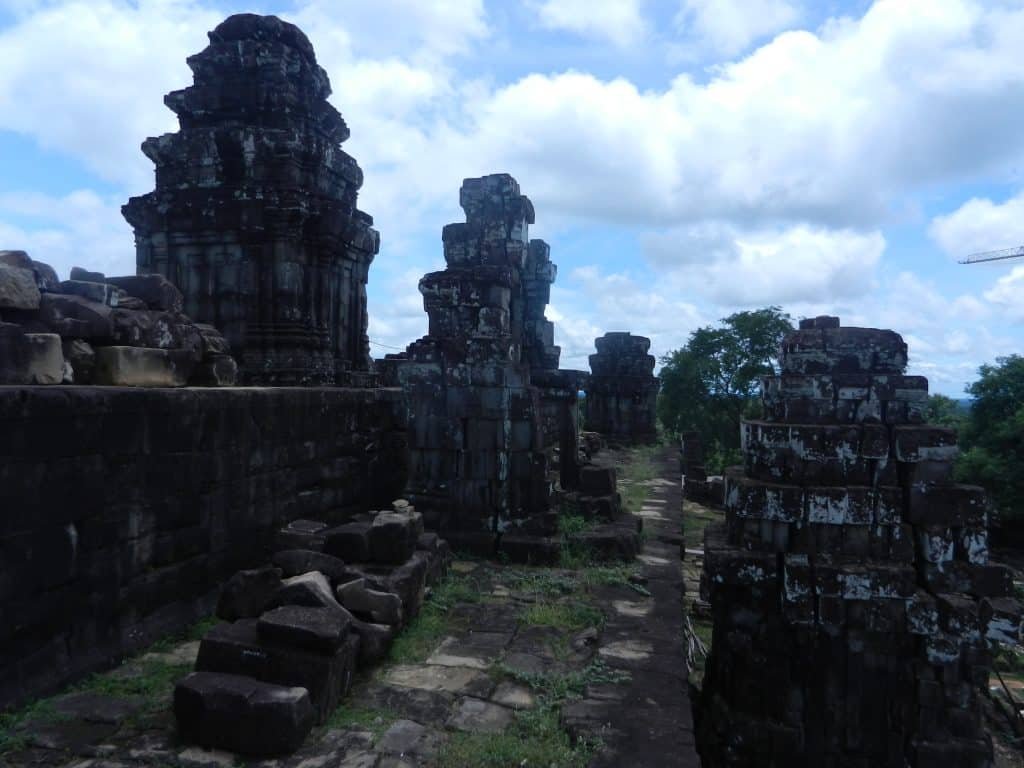
It’s also modeled after Mt. Meru (the mountain in the center of the Hindu and Buddhist universe), and it was constructed as five increasingly small platforms standing on each other, each with towers in the four directions (above).
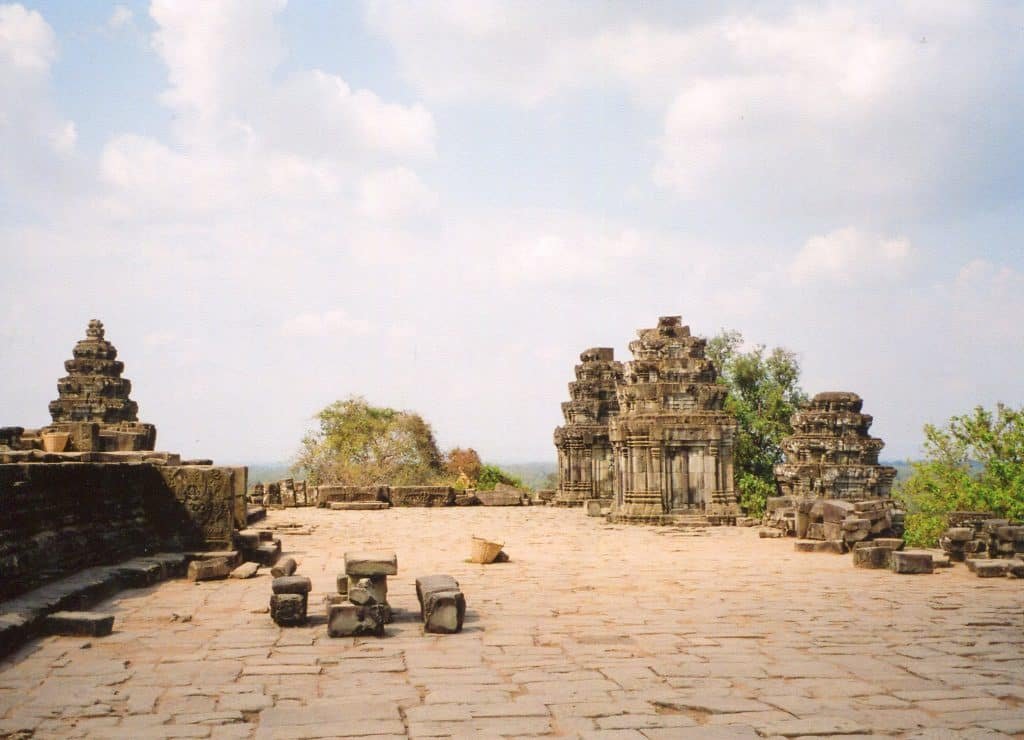
The above picture is from the top terrace.
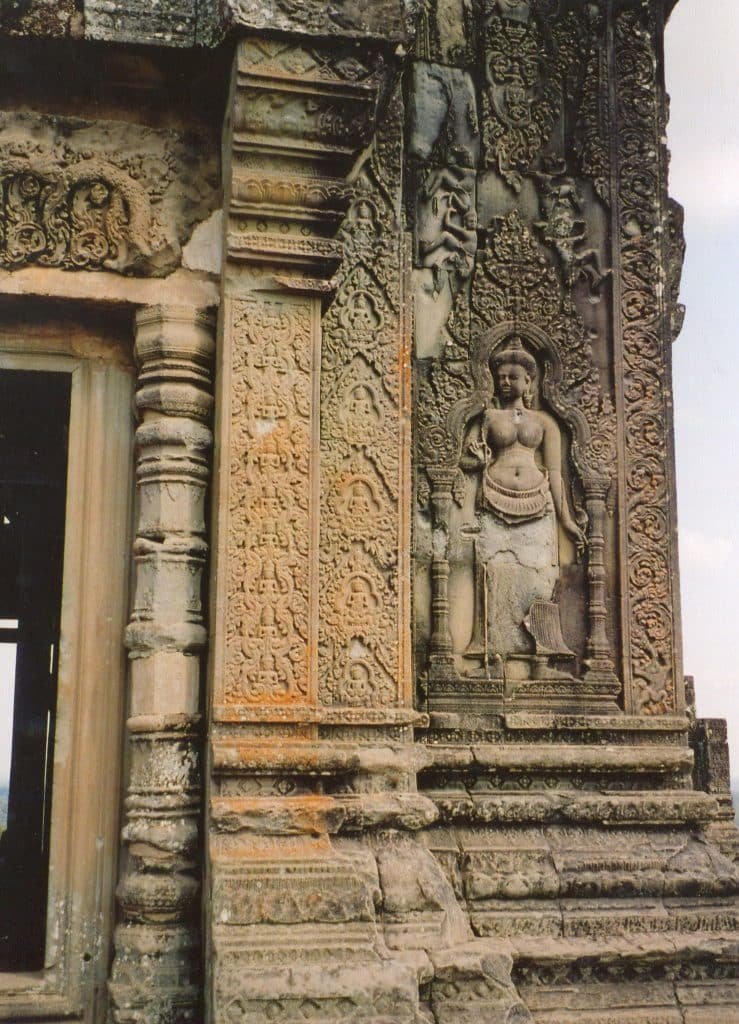
The carvings on the shrine at Phnom Bakheng’s summit have Preah Ko’s regal elegance.
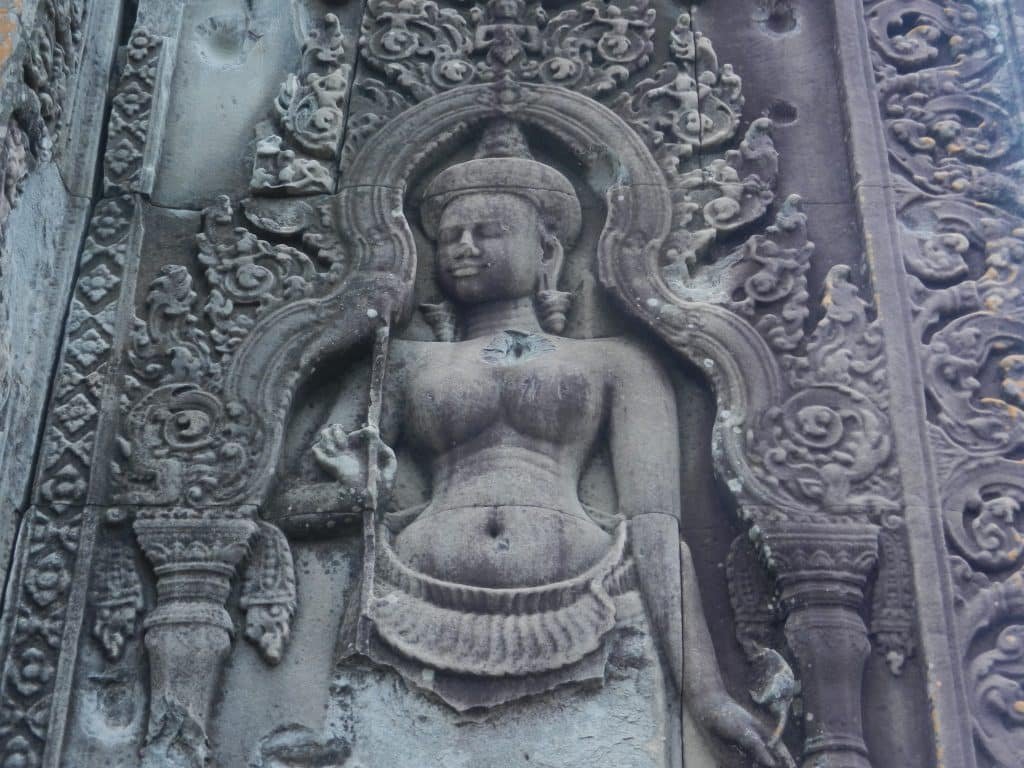
Its door guards are in the same refined and aloof style.
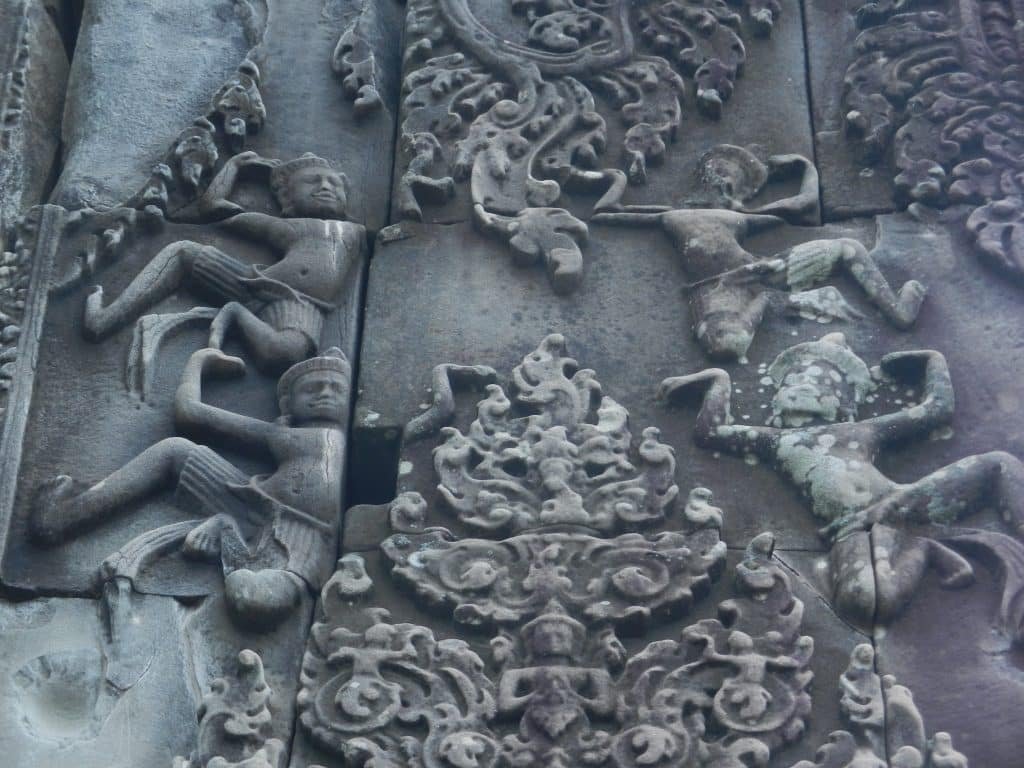
These apsaras fly above the door guard, adding ethereal grace to the scene.
2. Phmon Bakheng’s grandeur exceeded the Bakong’s. Yasovarman built it by carving it from the top of a 220-foot-high hill. This lofty base enhances the feeling that the temple is the center of the universe. It’s just down the road from Angkor Wat, and when you climb it, you can look down on its pineapple-shaped towers. Survey the opposite direction and Lake Tonle Sap spreads below. Its glimmering surface under the ebullient sun stands out from the forest and fields. Even a Pizza Hut would seem sacred up there.
3. Forty-four brick towers surround Phnom Bakheng’s base. Sixty sandstone towers grace its terraces. On the summit, four towers surround the central shrine, like the four mountains around Mount Meru. 44, 60, and 4 add up to 108, which is a sacred number in Hindu and Buddhist cosmology. So Phnom Bakheng was a model of the universe.
Yasovarman built on and extended ideas and aesthetics that his father expressed:
1. The combination of symmetry, immense dimensions, and elegant carvings into aesthetics that highlight the power and sacred refinement of the king and other elites.
2. The temple-mountain as the center of the royal cult.
3. Numerical symbolism that correlated the royal temple with Hindu and Buddhist cosmology.
4. Associations of the royal cult with Shiva’s power.
5. An enormous reservoir and thus connections between the king and the annual monsoon and flooding of Tonle Sap.
Yasovarman made these more dramatic, and solidified them as basic Khmer thought patterns for much of Angkor’s history. The were established as models of order in the growing empire that was based on rice farming and the regularity of monsoons and Lake Tonle Sap’s annual flooding.
Other kings would build bigger monuments in the neighborhood 200-300 years later. Angkor Wat is the largest temple in Southeast Asia, but Phnom Bakheng looks down on it. Yasovarman’s spirit seems to remind its builder, “Nice try kid, but you still must respect me.”