
Preah Ko is one of the most important temples that the Khmers built. King Indravarman I erected it over 250 years before the Khmers constructed Angkor Wat–shortly after he took the throne in 877. It set standards that Angkor’s builders followed for the next 500 years. They were so high that they remained hard to beat.
Preah Ko was one of the first Khmer temples to use symmetry on a vast scale. People were migrating into Angkor’s area from the east in the ninth century, and Khmer kings were marshaling them to clear jungles, plant crops, and dig huge canals and reservoirs. Kings were giving these settlers into a new land a common system of meanings to cohere in.

Above is the entrance to Preah Ko–from its outer surrounding wall (it’s poorly preserved) towards its central towers. Angkor Wat is also a symmetrical system of walls and courtyards that lead you to a central group of towers. Indravarman I conceived Preah Ko in this way more than 250 years before.

In the above photo, I walked a few paces towards the center and turned right. This is the inside of one of Preah Ko’s eight long rectangular side buildings. Four are on each side, so I saw the same structure on my left. Other buildings and some statues were duplicated on each side of the axis from the entrance to the main towers. Angkor Wat and most other Khmer temples have this bilateral symmetry too. The rituals that occurred in Preah Ko were probably as precisely coordinated as the buildings.
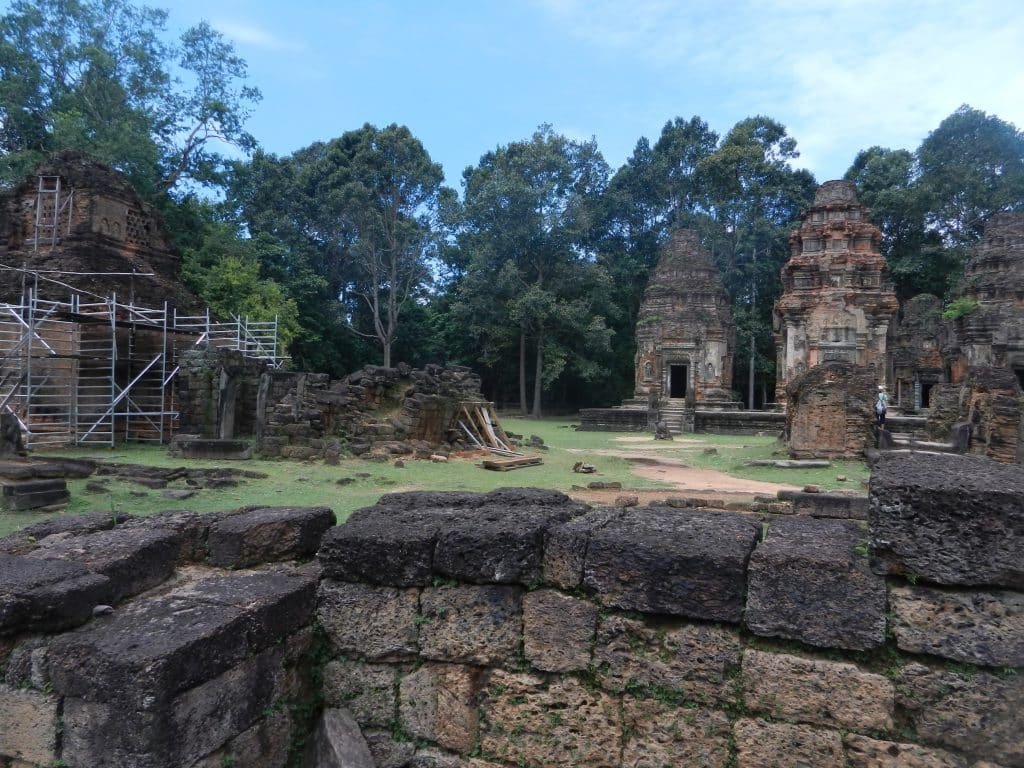
I’m a little closer to the central shrines in the above shot–in a T shirt and baseball cap rather than the regal garb of Indravarman and his elite priests. But I could still appreciate some of Preah Ko’s formality. I’m looking from another rectangular building towards a construction which scholars conventionally call a library. Another one faces it from the other side of the walkway towards the center. Angkor Wat and many other Khmer temples have them too. They might have been used for storing many things used in rituals–perhaps texts, incense and gowns. Nobody wanted my T shirt though.
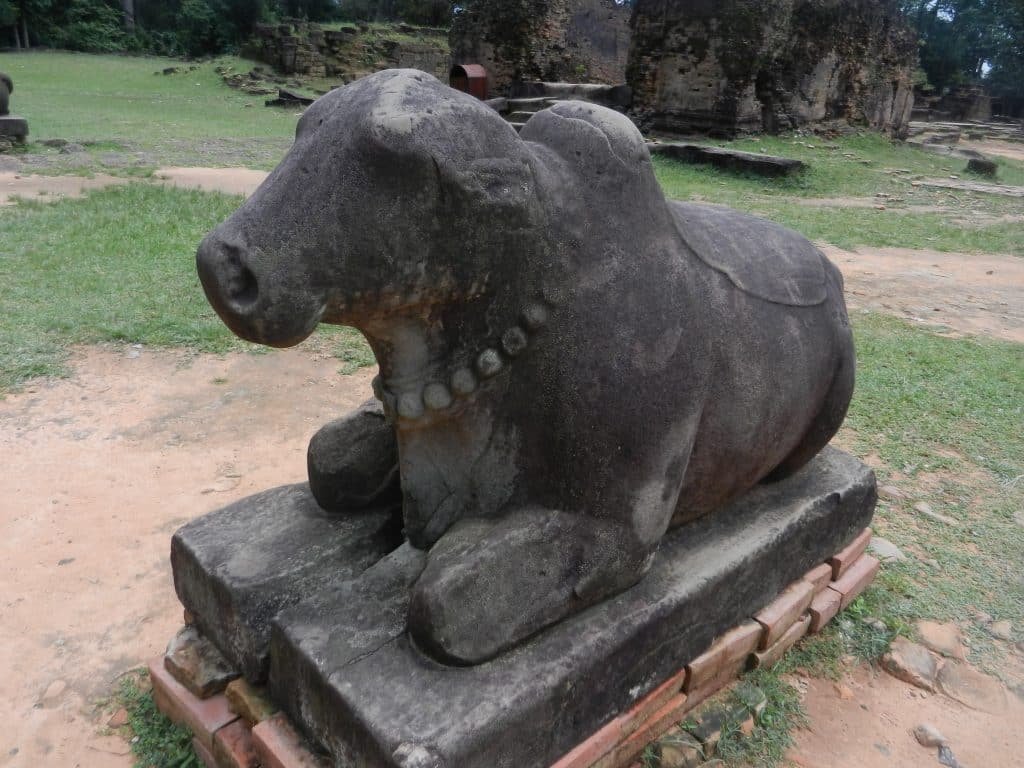
I then arrived at this dignified sculpture. There are three of them–one in front of each of the central section’s front towers. The bull is Shiva’s mount. Preah Ko was dedicated to him (its name means Sacred Bull), like most Khmer temples before Angkor Wat (which is a trophy home for Vishnu). Sculpture from the Preah Ko period is known for strength and aloofness–what its builder probably wanted to project.

My last time there was during the rainy season. The monsoon slams the area with suddenness and power that make it seem divine.
Indravarman I and other kings linked this force of nature which fertilized the fields for Angkor’s increasing population with their own authority and with Hindu deities and their priests.
Preah Ko’s symmetry and stateliness must have been associated with the regularity of the monsoons. Since the Khmers believed in magic, folks probably thought that they helped ensure the coming of the rains each year.
But Preah Ko has another side. It also set a standard for elegance which inspired Khmers throughout their history. This temple balances strength and refinement so well that I think it’s one of the finest works of art in Asia.
You know you’re heading for the heavens as soon as your foot leaves the ground.

The ornate bottom step to Preah Ko’s central section makes it clear that it’s a special place.

Above is one of the six shrines in Preah Ko’s central section–three line a front row, and three are in the back. I’ve always enjoyed the style of columns that flank the door. They sure don’t look like the classical columns that Westerners are used to.
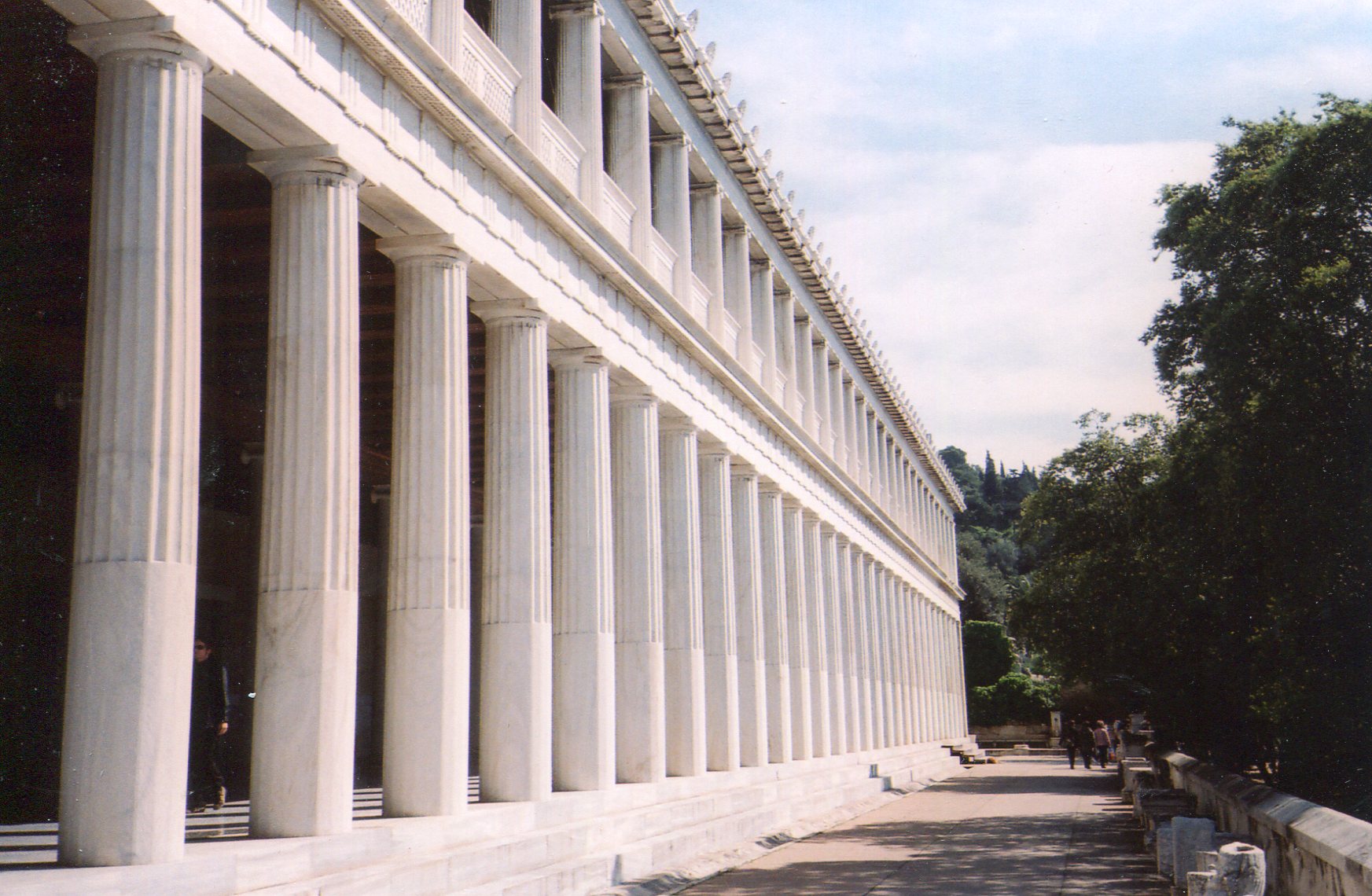
Above is the Stoa of Attallos II in Athens’s Agora. It’s actually a reconstruction that the American School of Classical Studies built from 1953 to 1956. It illustrates the type of column that Westerners have most resonated with. They’re straight and abstract, and they’re in a linear sequence that’s so pure that the line becomes the main focus rather than any decoration. Abstract shapes and linear relationships have been intellectual centers of gravity in the West since ancient Greece. But Khmer society was a different world.
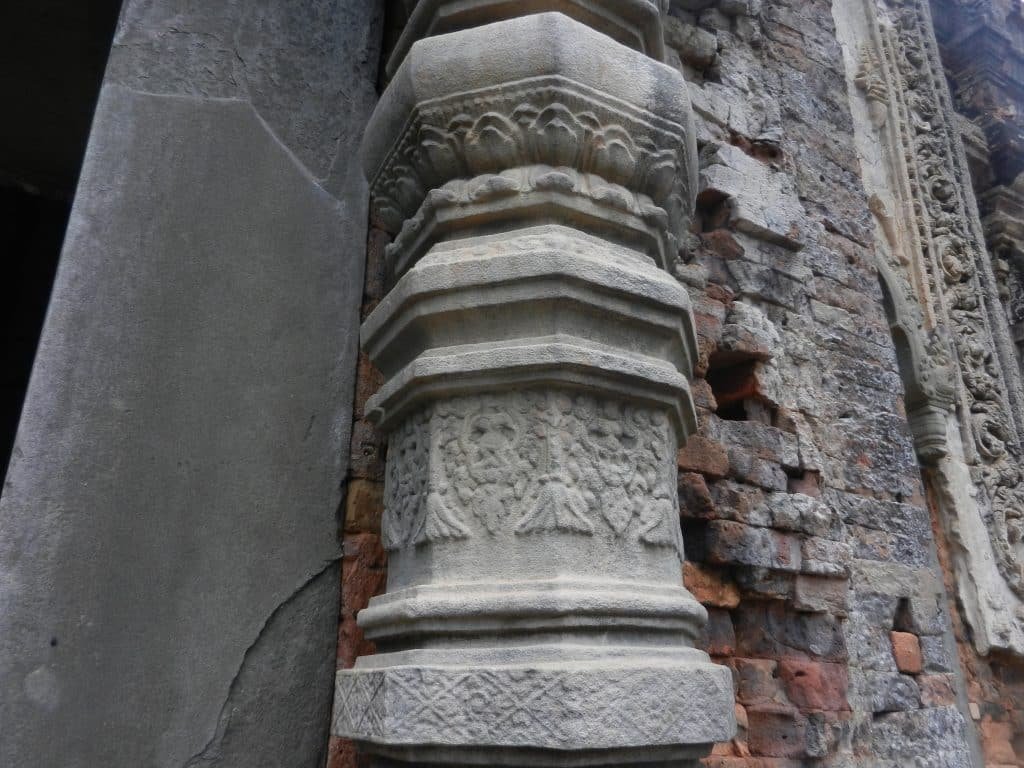
In Angkor, the decoration mattered as much as the form.

Khmers got the idea of creating a profusion of forms on columns from India–in both lands it reflects the abundance of life forms in the tropics and the metaphysical energies that seem to generate them. The columns aren’t abstract lines; they pulsate with energy.
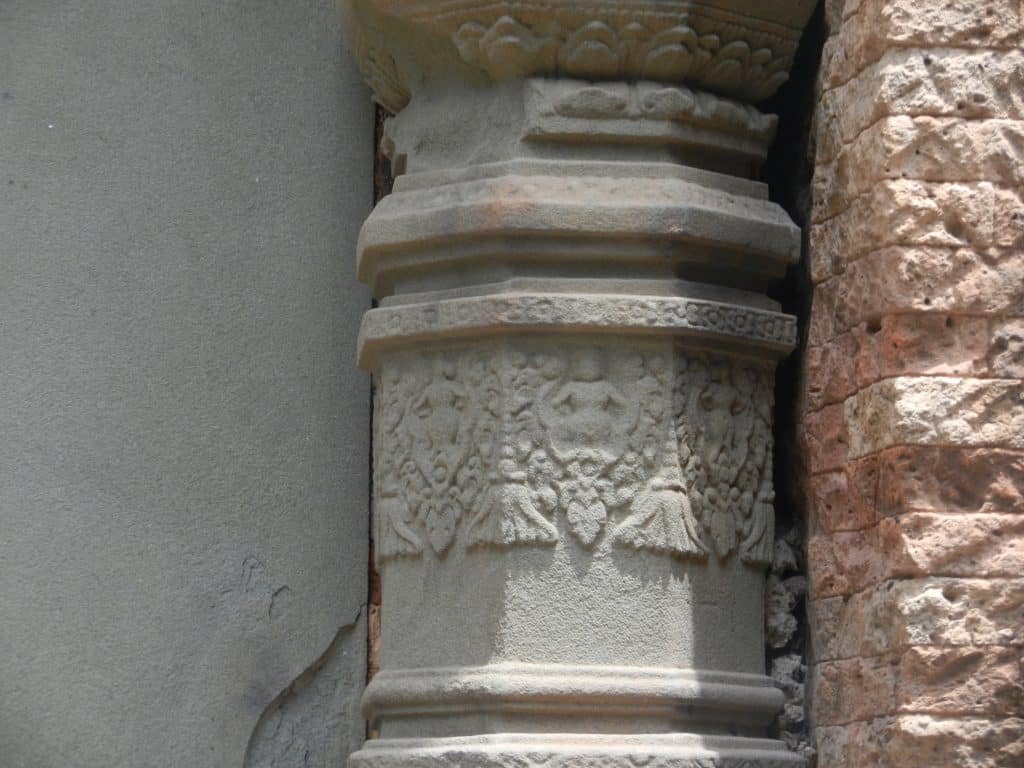
The shot above shows a common Khmer motif: dense vegetation surrounding a human figure. The patterns seem animated as though they could magically bring the rains that fertilized the rice crops that the growing Khmer state depended on.
But they’re also elegant: The symmetry of the carvings and of the columns themselves, the columns’ narrowness, and the fine transitions between each section of the columns make the columns seem like they’re from celestial realms. They concentrate nature’s power and render it spiritual and benevolent.
The finest Khmer art balances power and grace. But we have only scratch the surface so far. We’ll enter Preah Ko’s heart in the next post.