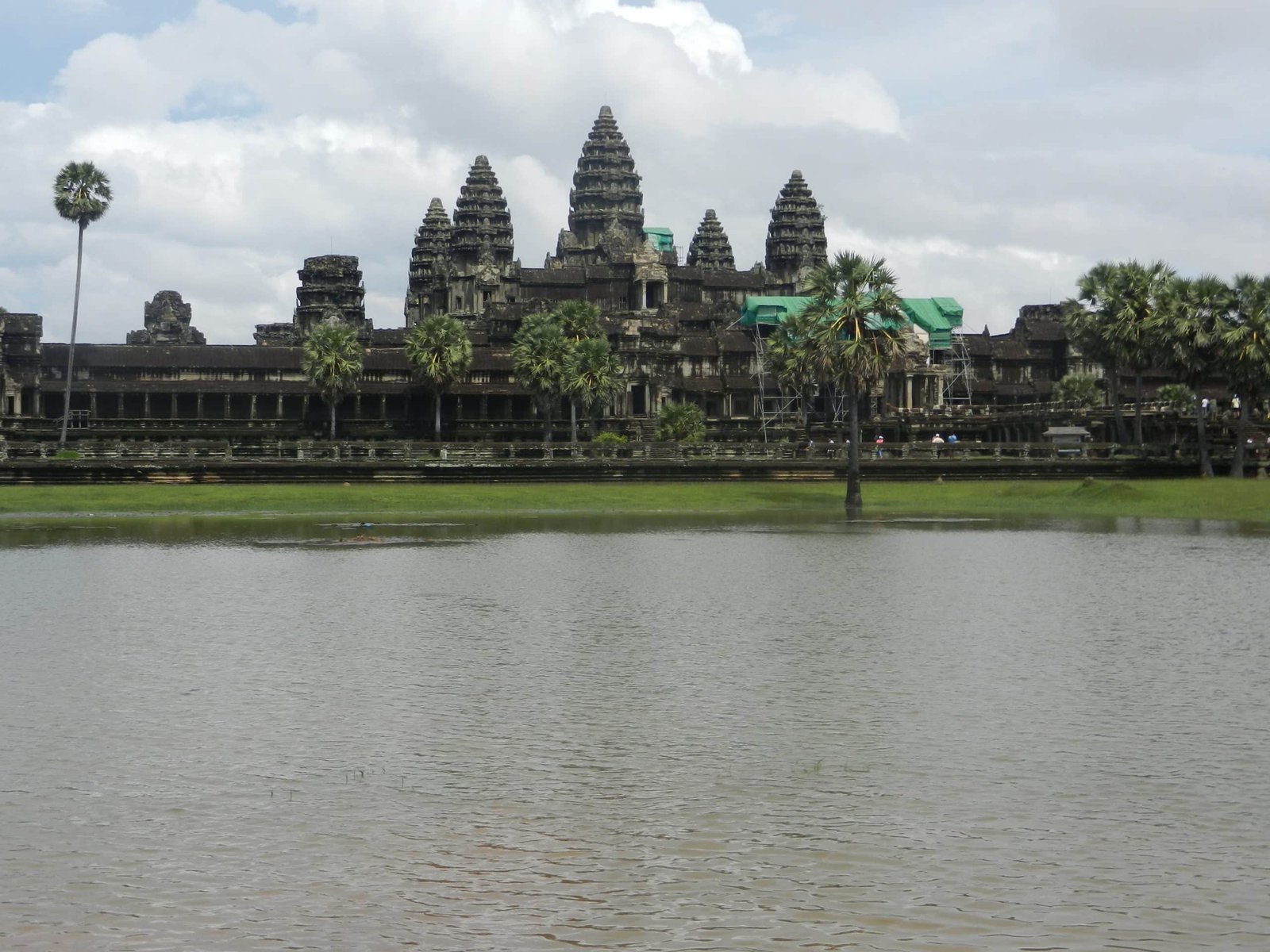
Angkor Wat was built in the early twelfth century–exactly when the French pioneered Gothic architecture in the Basilica of St. Denis. Europeans constructed towering naves and choirs surrounded by stained glass that filled them with light. Khmers couldn’t fashion arches to span large volumes, so the stone rooms they built were narrow and dark. But they made up for it by going horizontal–Angkor Wat’s total area is almost a square mile. It’s filled with sculpture and forms that mix Indian and native symbolism. Gothic style and Angkor Wat represent two great cultures’ ways of seeing the world.
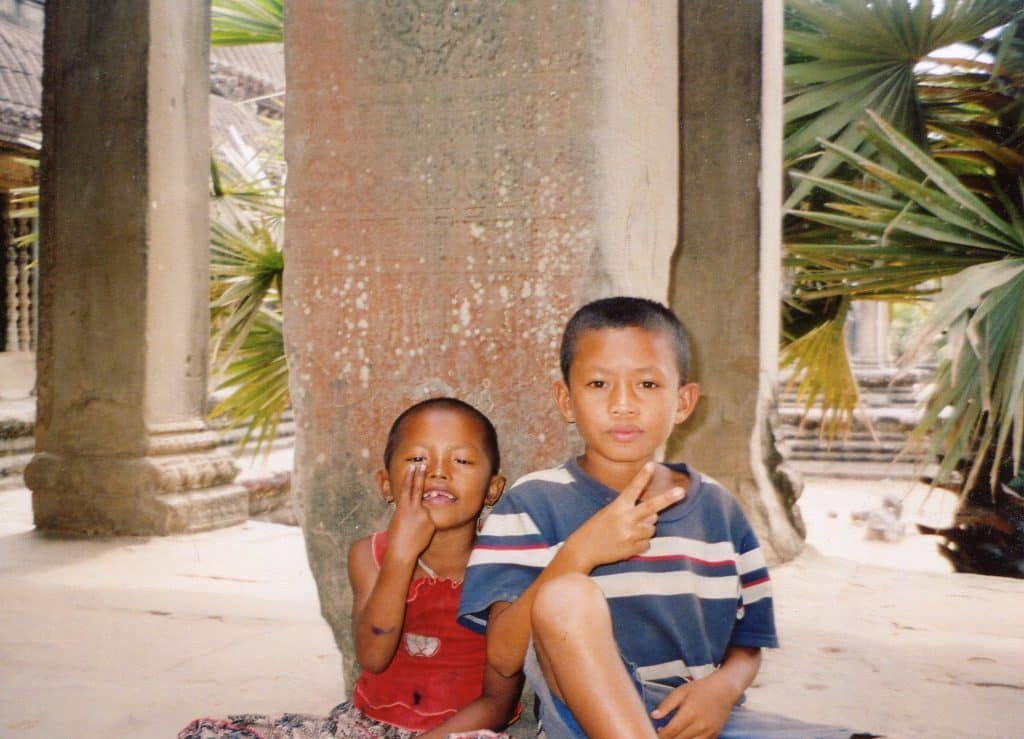
Angkor Wat emerged as suddenly as an apparition when I visited it. Its towers punctuated the dark foliage like diamonds and soared above the treetops.
Its visage intensified as I approached the parking lot across the road. The massive grey walls seemed to spread over the whole earth, and the towers in the center thrust into the heavens. Angkor Wat looked like a city and a mountain range at the same time.
It seemed too supernatural to be categorized, and the king probably wanted it that way. He built this frontage to overwhelm all who would see it. Farmers tending their rice fields and cozying in their stilt homes would have had no doubt about its sacredness or who was the boss.
Historians have seen different reasons for its construction. It was likely a mausoleum for Suryavarman II and a temple for the Hindu god Vishnu (Suryavarman’s soul supposedly joined his when he passed away). The building faces west but most Khmer temples point to the east. Khmers associated the west with both Vishnu and the afterlife. The king might have assumed Vishnu’s role in the Hindu Trimurti as the sustainer of the universe, between Brahma the creator and Shiva the destroyer—a dream team to identify with if you want to run an empire.
Other historians say that Angkor Wat’s measurements correspond with astronomy and Indian myths about gods. They concluded that it might have been both an observatory and a giant map of the universe. The art historian Eleanor Mannikka wrote that the sun rises over different towers on important days, including summer and winter solstices. Ancient Indians and Khmers identified Vishnu with the sun, so Angkor Wat was probably related to its movements.
But people at Angkor Wat probably did more than observe the sun. Mannikka found several repetitions of the numbers 28, 32, 45, and 108 in its measurements. These numbers symbolized Hindu ideas of gods and movements of stars, planets, and the moon. She also noted that the creation of the universe was carved on the temple’s eastern side, where the sun rises. Angkor Wat’s plan thus might have integrated the cosmos, the forces that created it, the state’s order, and the king’s power. If so, it was the center of the whole shebang as the Khmers saw it (some of Mannikka’s ideas are controversial, but since these numbers occur several times, they probably did express Khmer ideas of the universe to some extent).
Others have seen Angkor Wat as a spiritual quest. A walk from the entrance to the center might symbolize the soul’s journey towards the source of creation. The main tower represents Mt. Meru, which ancient Khmers and Indians saw as the center of the universe, where the rain-bringing god, Indra, presided in his bejeweled palace. A procession to the temple’s center might be a journey to the most meaningful and powerful place in the universe.
This temple has many facets because the Khmers were unifying their perspectives of the world with it as their empire was growing. It expresses the scale of their kingdom during its glory days.
A broad flight of stairs lifted me from the road to the bridge that crosses the more-than 650-foot-wide moat.
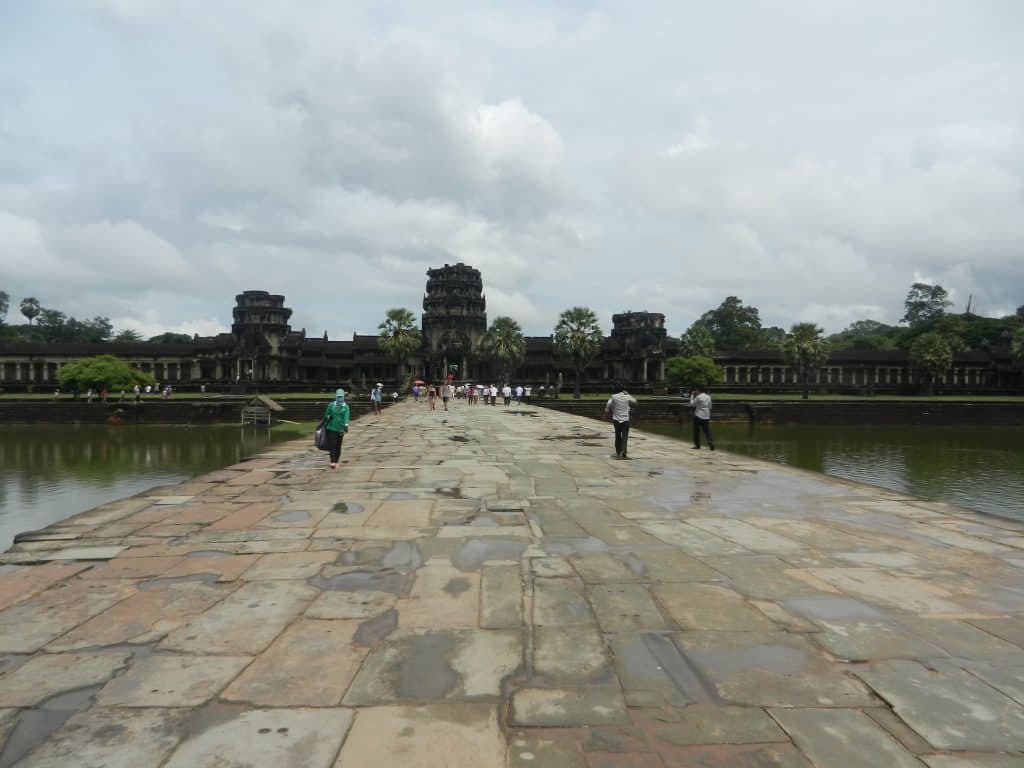
I then gazed across the moat at the more-than 700-foot-long entrance of the first enclosure. Three multi-tiered towers crown its central section, long columned corridors project from each end, and a stately pavilion with a gabled roof climaxes the far end of each corridor. The whole section is large and symmetrical, but the towers and reliefs of Hindu gods and female dancers embedded in dense vegetal patterns (which are carved on walls, columns, and lintels over doorways) are elegant.
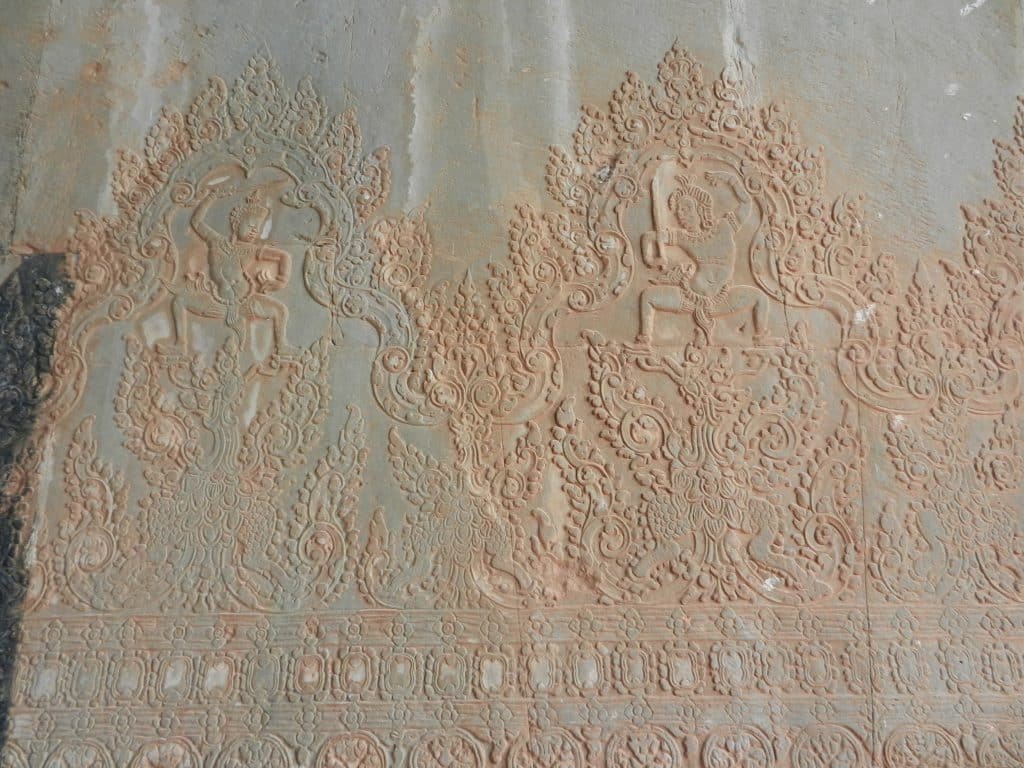
This structure impeccably combines power and refinement.
I entered this building’s central section through a portico fronted by a colonnade and crowned with stacks of tiled roofs, but the darkness that suddenly enveloped me contrasted with the opulent exterior. A long, cavernous gallery extended from each side of the entrance hall.
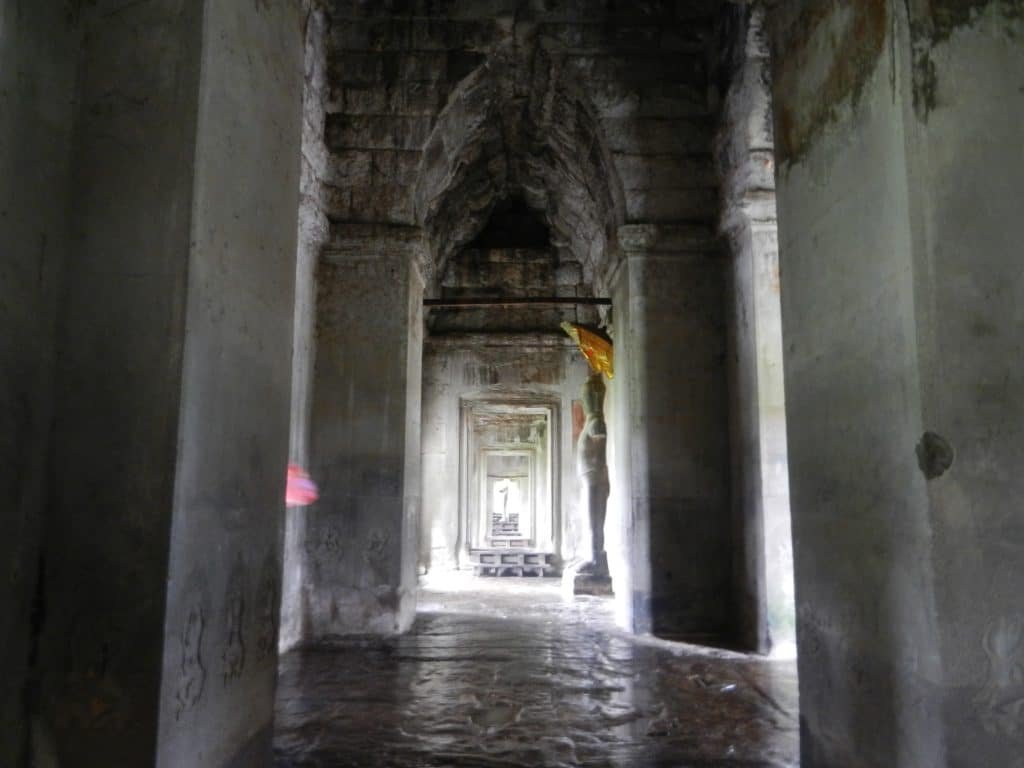
Priests in the galleries accepted offerings and recited prayers for worshippers who respectfully kneeled. The smell of incense, the dusky interior, and the huge stones meshed in an aura of mysterious power.
I walked out the other side and into the main courtyard and found it even more dramatic than the first enclosure’s entrance. The central towers loomed ahead and a broad and straight causeway with naga-shaped balustrades on each side led towards them. This was an ideal place for royal processions. The blazing sun (or the restless clouds during the monsoon season) must have given them even more luster. The power that I felt from it can encourage people to think that the spires transmit the energy that created the universe.
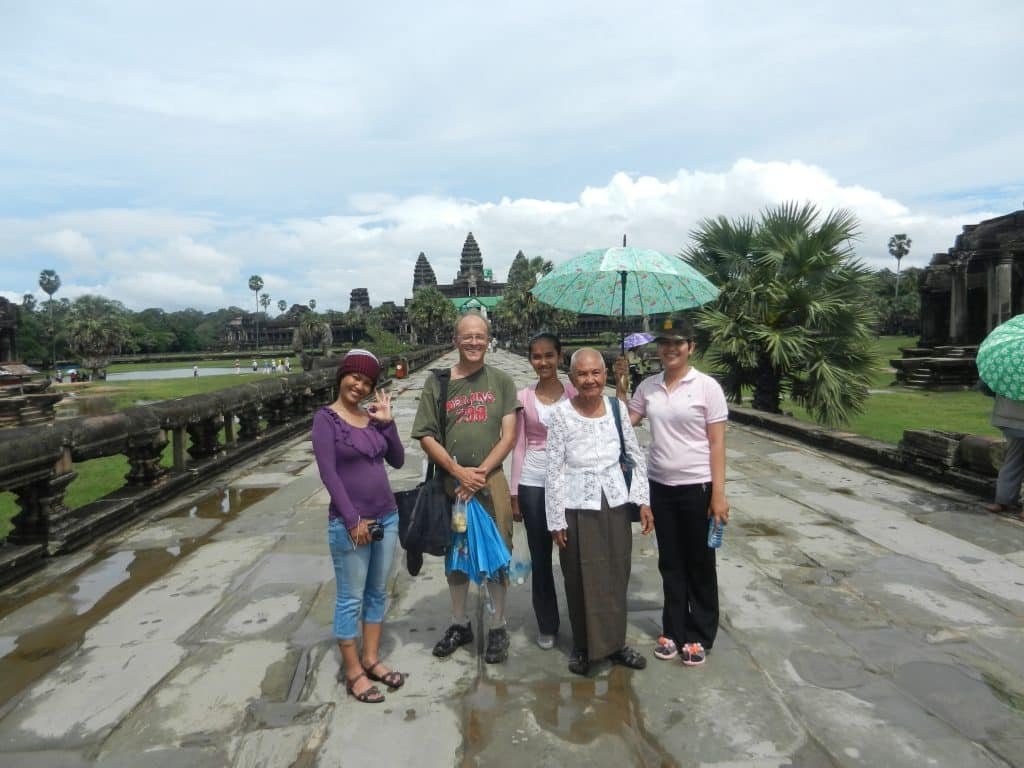
The excitement kept growing after I crossed the courtyard. I arrived at the steps of a large cross-shaped terrace in front of the central towers. This platform punctuates the transition from the causeway to the main section. It would have been ideal for ceremonies, which thousands of people might have gawked at. The historian L. P. Briggs felt that people conducted public rituals there. Female dancers might have performed with sparkling crowns and tinkling jewelry. They couldn’t have had a more stirring backdrop.
After crossing the platform, I ascended the middle section’s front steps, entered its portico, and reached two corridors that branch off to each side. They make up one of the four passageways that form a rectangle around the center. My procession had abruptly changed from the huge open courtyard to long covered corridors that surround the main towers. I was about to enter another world.
All four walls around the towers are covered with stone friezes in a style that’s elevated far above the lives of the farmers who lived nearby. The faces of the figures are so aloof that they seem too superhuman to notice ordinary people. The carvings are about 6 1/2 feet high, and they extend about 2,000 feet around the temple. The sculptures illustrate four themes: battles between Hindu gods and demonic beings opposed to them, epic battles between warriors for the throne of India, the creation of the universe according to Hindu mythology, and Suryavarman’s authority. These whopping subjects and the enormous space they cover make the carvings seem regal rather than intimate. The friezes are key messages that the great king wanted to give all who enter.
The raised floor makes the friezes even more sublime. It’s about eight feet above the ground, and the space between the carvings and outer edges is wide. To see them from the soil, I had to stand several yards away, but I couldn’t observe details from there. The reliefs were not made for casual viewing; they demand full attention. It’s not known whether only priests used the corridors to perform rituals, or if a larger public was allowed in. But whoever walked through them must have felt deep reverence.
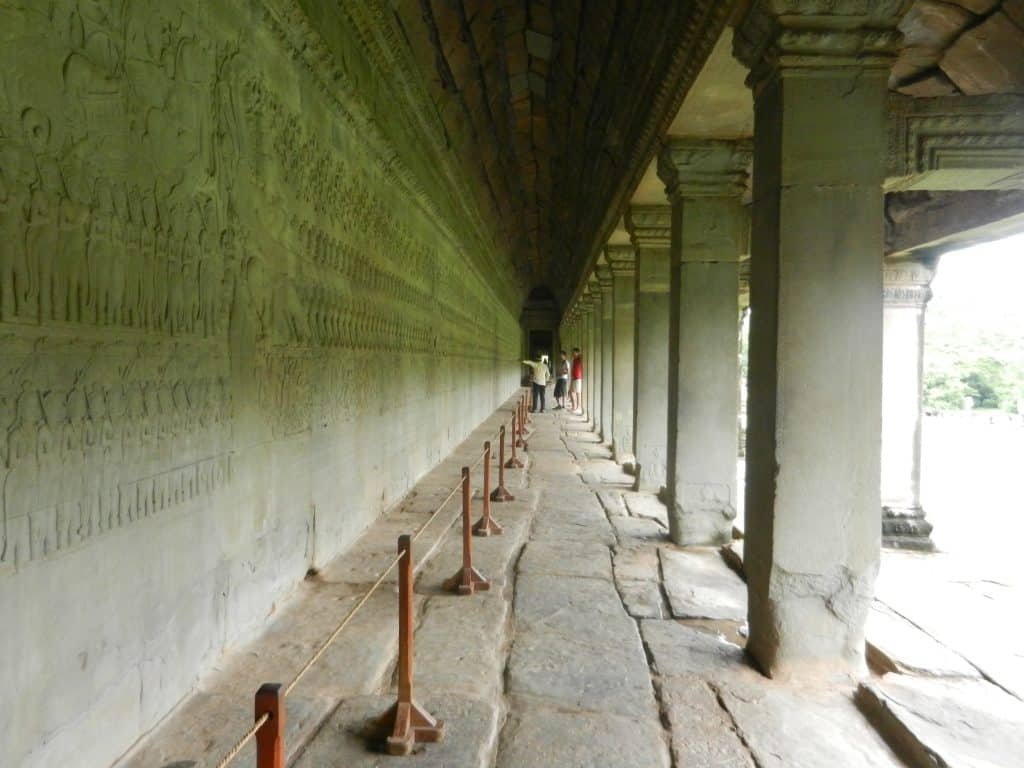
Plays of light animated the corridors even more. Many shades of green foliage flickered behind the outer columns as I walked through. The pillars created shifting combinations of light and shade on the friezes and floor as the sun blazed. The creative forces of nature seemed to energize the mighty carvings. The sculptures don’t just tell stories—they radiate power.
People have usually read the carvings counterclockwise in the last 100 years, but the Angkor Wat specialist Vittorio Roveda said that this is only a convention. Scholars don’t agree about the direction or the starting point, but since the action in the carvings moves counterclockwise, I followed the herd and began at the entrance portico. I thus turned right and explored the southwestern wall. It features a mythical battle in which two armies fight for India’s throne.
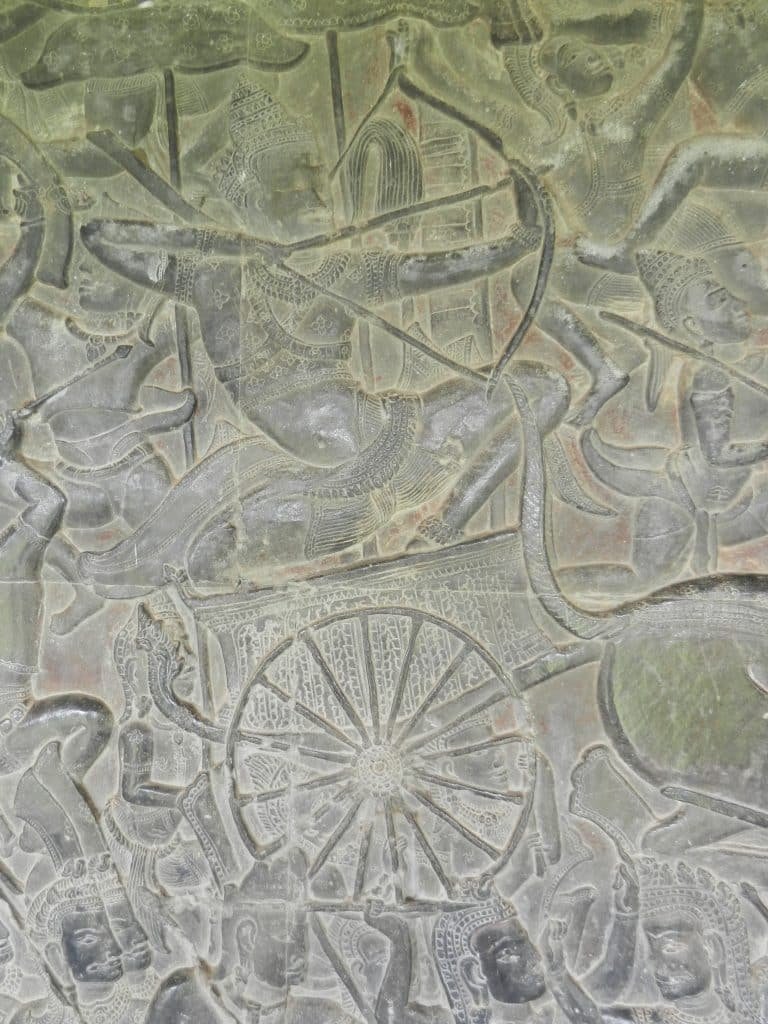
Closely packed lines of soldiers march, chariots race, furious horses and elephants charge, warriors stab with spears, and bodies pile up.
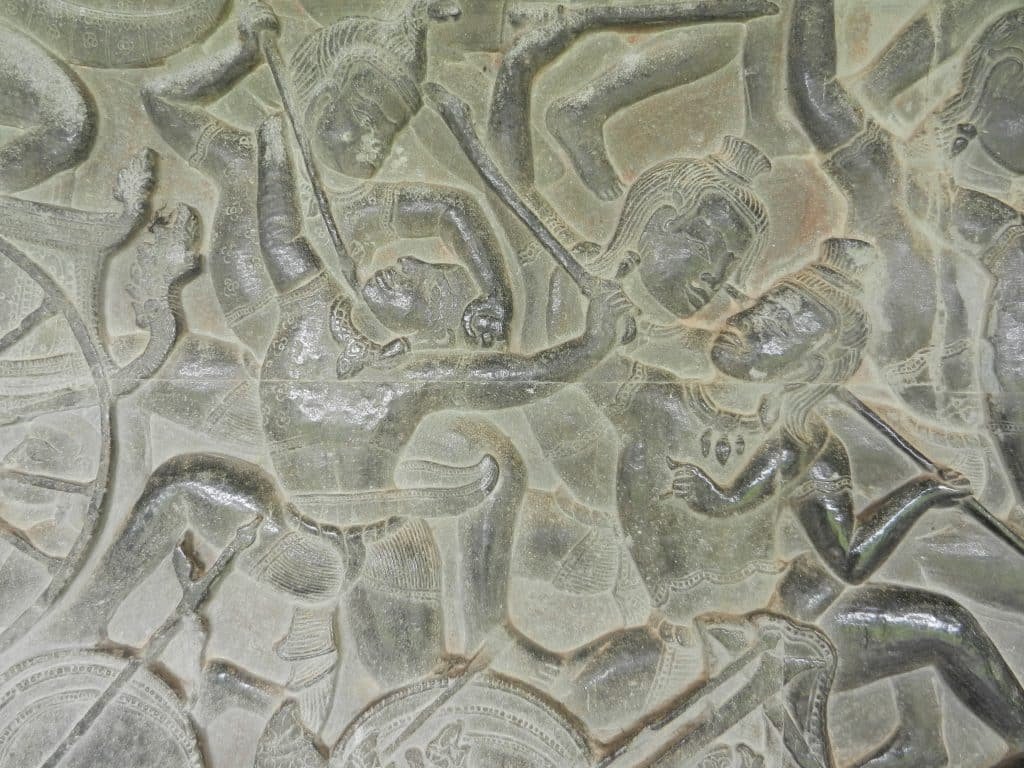
Burly men close enough to hug thrust their spears at each other. The huge panel crowded with intense action can make visitors wonder if they will disintegrate before finishing the circuit.
But the pavilion at the end of the corridor has a rarity at Angkor Wat: a scene of ordinary people’s lives. It’s a celebration with dragon-headed boats rowed by oarsmen, possibly on Tonle Sap (it’s poorly preserved today). On the shore people dance energetically, a woman cradles a toddler, and two ladies under a pavilion take food from a kneeling servant. Here is that timeless mixture that’s common in Southeast Asia: a religious festival, fun, food, families together, and ideas that they are all associated with spiritual power and political leaders. Glory to the gods and the king!
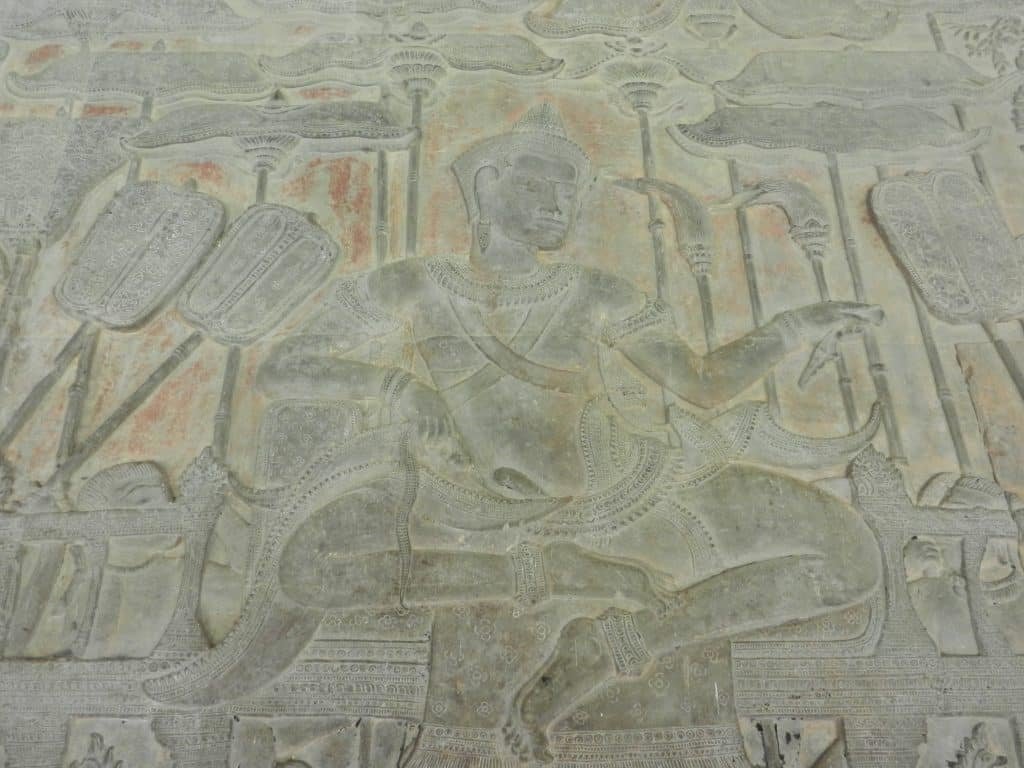
When I turned the corner, I was back to more serious business because I was approaching the great Suryavarman II. Every important type of person in that time is carved in an epic procession. Ministers, princes or governors, religious ascetics, and upper class women make it grand enough. But the army marches in it too, with commanders presiding on top of elephants (their ranks are identified by the number of parasols raised over them). The king sits on an elaborate throne with naga-headed feet. He is on a larger scale than everyone else, and he’s giving orders to officials and holy men while attendants fan him. Everyone kneels around him as he sits under 14 parasols (a number that signifies his supreme rank).
One group of soldiers stands out from the others. They sport long and wild hair, and they have often been called Thais because the word Syam is inscribed near them. The Khmers might have been distinguishing themselves from people they considered less civilized.
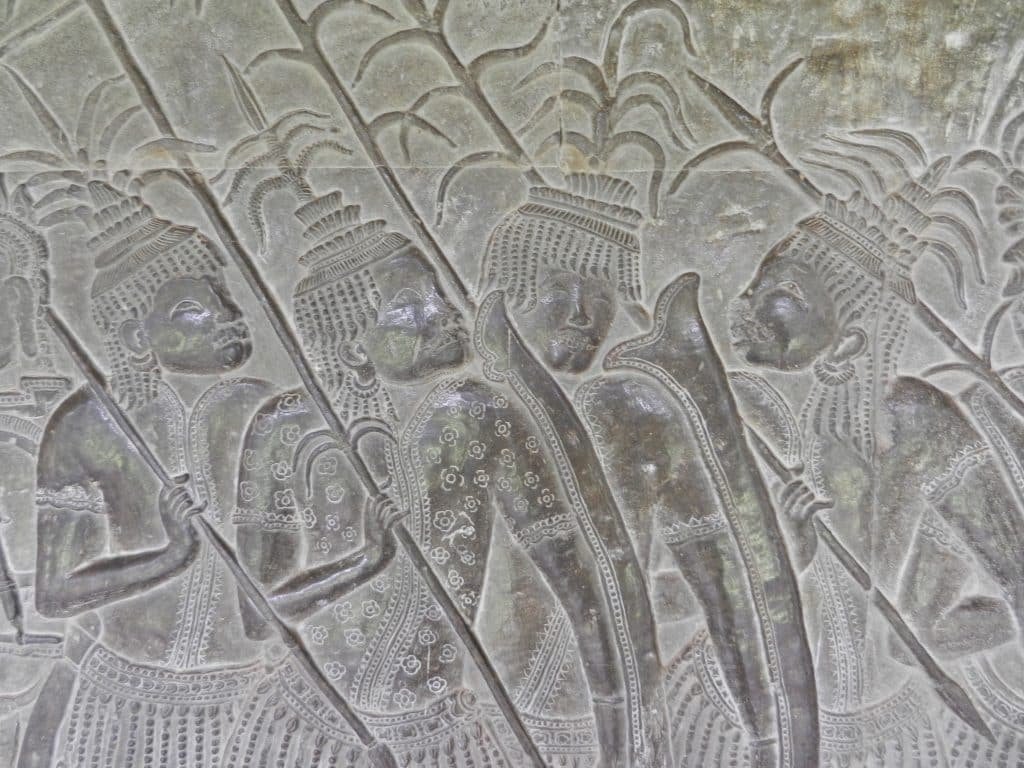
But Roveda wrote that Syam might have referred to dark-skinned people in general, and that these soldiers were probably mercenaries or Khmer residents of a neighboring land which may or may not have been where Thailand later developed as a nation. Whoever they were, the striking differences between types of soldiers highlight the army’s size and the procession’s scope—the army is cosmic rather than local. The parade is on an epic scale that reinforces Angkor Wat’s larger-than-life grandeur.
Suryavarman II appears a second time, grandstanding on an elephant and surrounded by a forest of parasols (15 this time) and soldiers carrying long spears. He’s on the same superhuman scale. Historians say that this wall has the first Khmer pictures of a known person in a sacred setting, but Mr. Big’s features look more idealized than realistic. This early portrait shows the king rivaling the gods in majesty.
The second major panel on this wall stupefies even more than the first. It depicts souls in heaven and hell. The blessed occupy the top and the damned suffer on the bottom. In the center, the Hindu god of death and judgment, Yama, sits on his ugly buffalo and wields clubs with his enormous number of arms. He directs the souls’ fates at the moment of death. Yama dominates the panel in this Khmer Divine Comedy, as Suryavarman II rules the first. Both are associated because they stand for the social and cosmic order. Whoever walked through there got a resounding message: Obey the king and heavenly bliss is yours; disobey and be vanquished. Extremes of grace and cruelty are close on this wall. Don’t make the king mad.
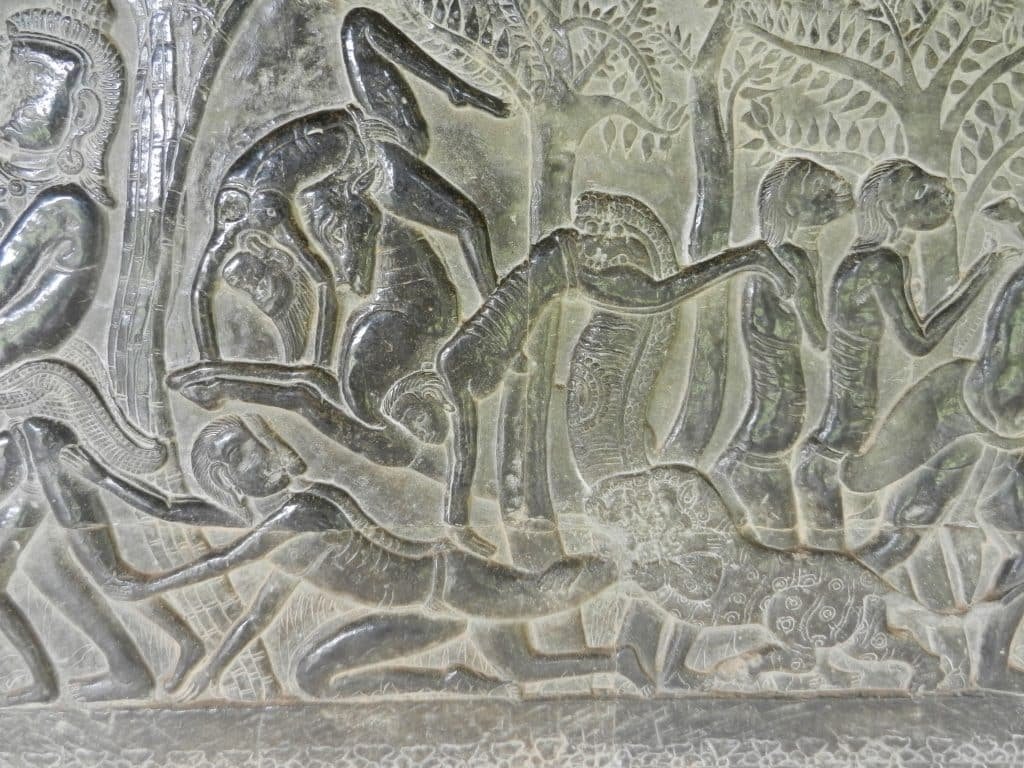
Inscriptions list sins and the tortures that they earn. Thirty-two hells await specific types of miscreants. Twelve are reserved for thieves, and stealers of land, horses, footwear, and rice have their own real estate. Many punishments are also given to people who disrespect priests and religious rituals. This focus on crimes against property and religious majesty suggests that Suryavarman’s court emphasized the political order and distinctions between elites and commoners. Adultery isn’t mentioned nearly as much. The carvings stress social hierarchy and the sacredness of rituals. In contrast to the Christian tradition which Europeans followed at the same time, the friezes aren’t particularly concerned with pleasures of the flesh. Khmer rulers seemed more preoccupied with obeying authority and more willing to allow enjoyment as long as it didn’t compromise their positions.
Transgressors in the reliefs are stabbed by deer horns, mauled by lions and dogs, crushed under rollers, flogged by demons, and pulled by ropes through their noses.
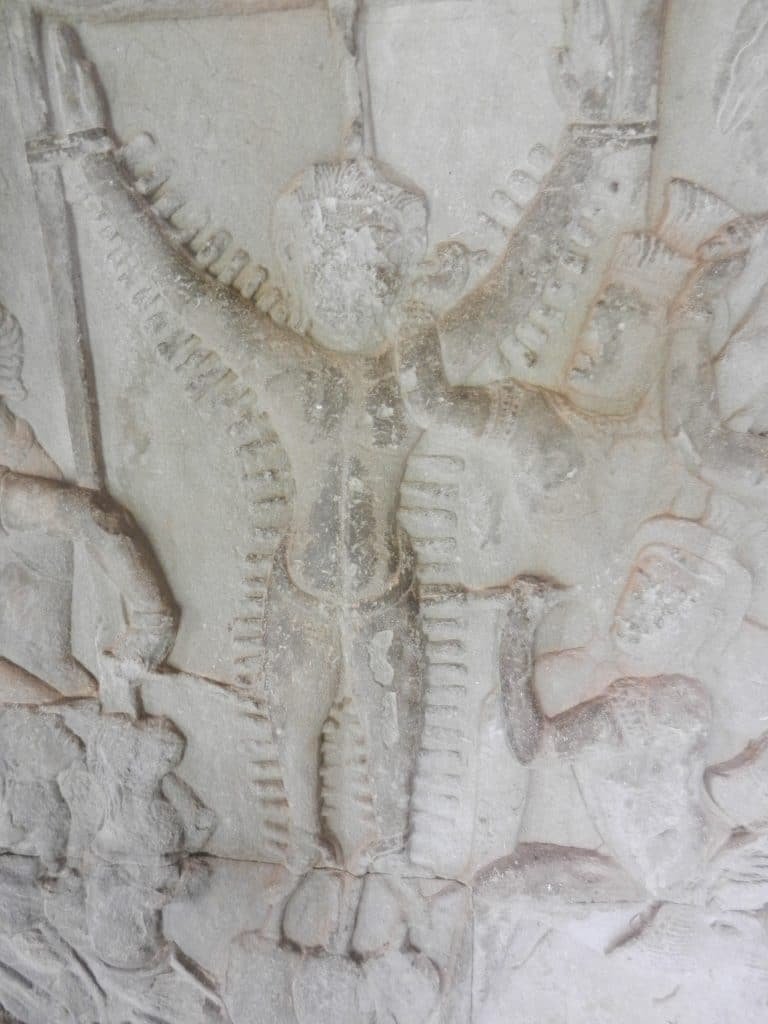
Nobody just gets a fine or a warning. Above them, elegantly crowned elites under parasols, wearing flowing skirts called sampots, amble in a procession to heaven.
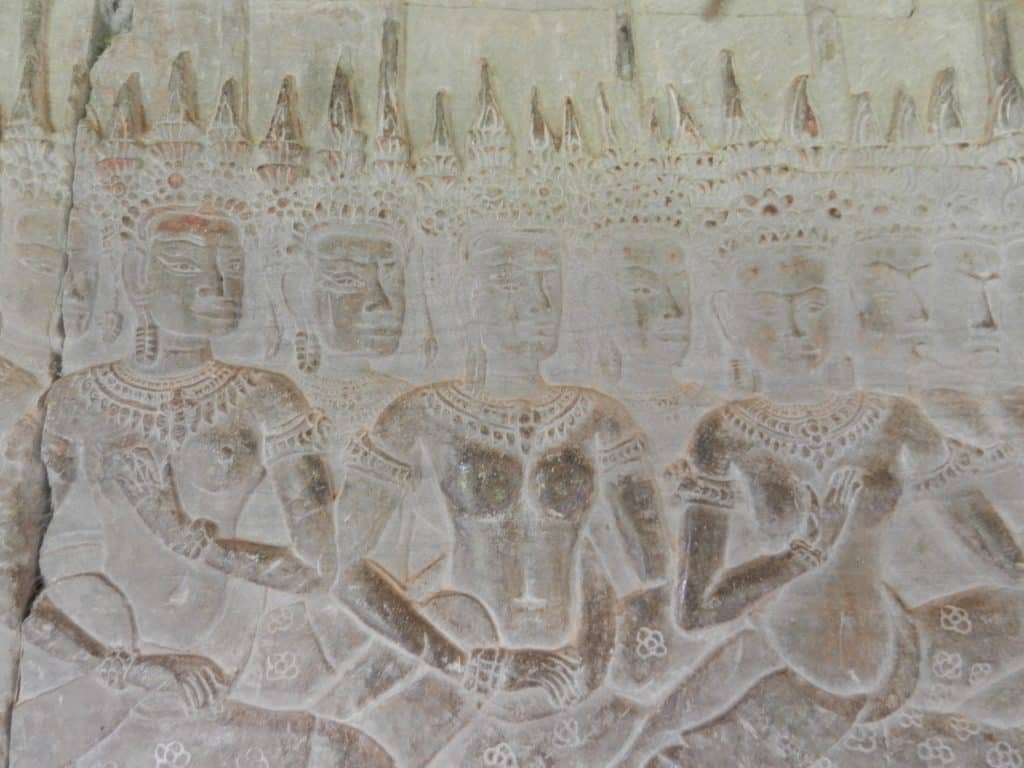
People only receive the ultimate punishments or rewards. There’s no middle ground.
Both panels on this wall are on an imperial scale, and the second thrusts a stern message about obedience in viewers’ faces. There is no Jesus, St. Francis of Assisi, or Dante’s Beatrice and Virgil to humanize the grandiose for the common person. People are seen in terms of these sweeping perspectives which struck me as aloof and sometimes harsh. I felt relieved to reach the end of the gallery, sit in one of the southeastern pavilion’s window frames, and enjoy a soft breeze.
How do you fathom this place? It’s spiritual and brutal. It’s elegant and forceful. It floats in the heavens and commands the entire earth. More mysteries quickly followed.